10 years since the launch of “Harnessing the River Murray: Stories of the People who Built Locks 1 to 9: 1915-1937” by Helen Stagg

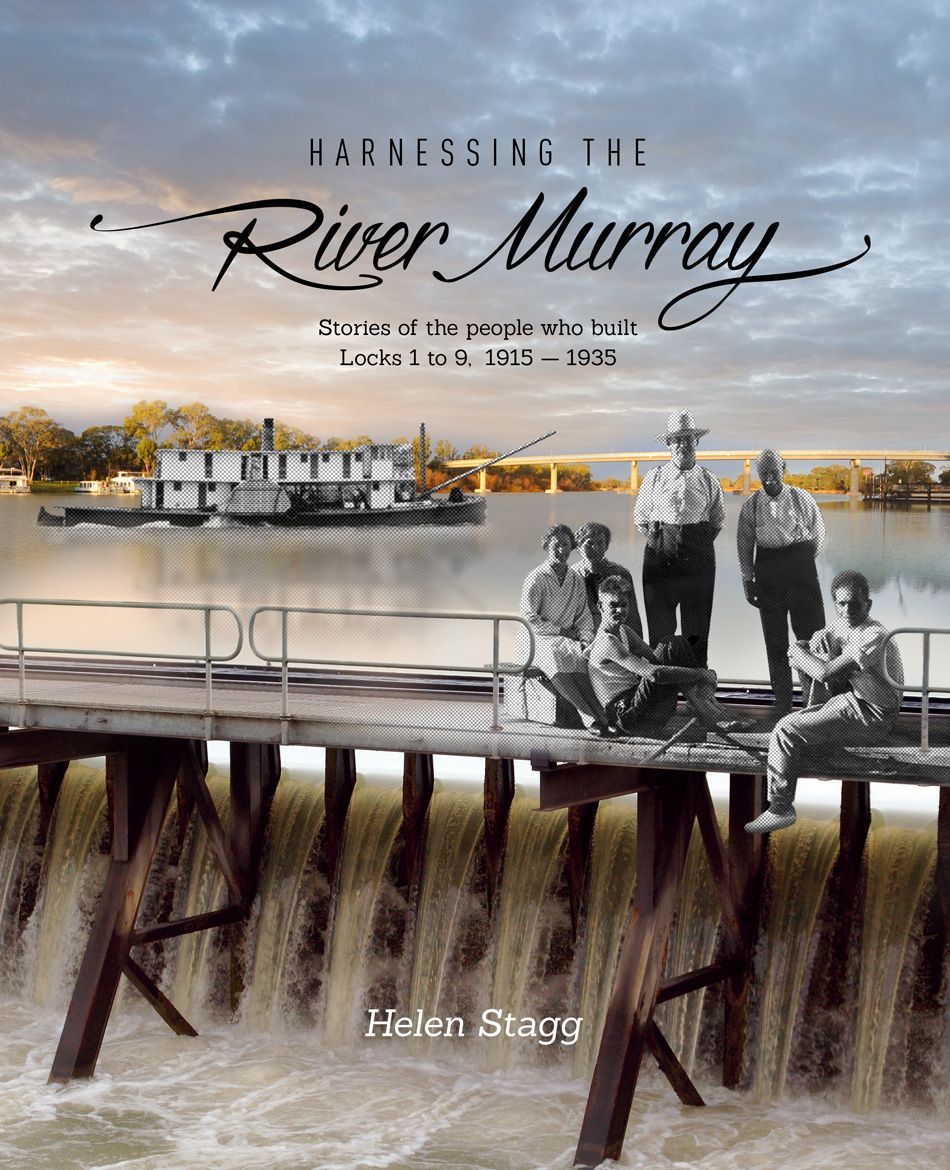
10 years ago today,”Harnessing the River Murray: Stories of the People Who Built Locks 1 to 9. 1915-1935″ was launched. I am not sure if you know what was involved in the writing, or how it evolved so here goes:
As a child, I was frequently told stories by my mum of her younger days growing up in the lock camps where her father was employed as an engine driver. He had spent almost 20 years on the works, from Lock 1 to Lock 5, then Lock 6 and finally Lock 7, before finally moving the family to Mildura on the completion of Lock 7. Over several years, I had been in touch with Max Pearson, of Waikerie, also a child in lock construction days, and discovered his passion that the history be told and recorded. So it was, that when I was undertaking my Masters in History, I interviewed Max as part of an Oral History project before writing my final Masters submission on the lock history. I was hooked!!

I had already invested a lot of time and developed a passion too to tell the little-known stories of families whose lives were lived in extraordinary conditions on the banks of the Murray at various locations. So when I realised at the end of my Masters, that in 5 years time, it would be 100 years since the great scheme began at Blanchetown in South Australia with the laying of the Foundation Stone on 5 June 1915, the duty fell to me to bring together the history in the form of a book. I wanted to commemorate the unsung men, women and children, who together with great engineers and relatively simple steam driven machinery like derricks, flying foxes and pile drivers, harnessed the Mighty Murray.

Max Pearson put me in touch with others in Adelaide who had also grown up on the locks, and I had contacts too in Mildura where I was living. I interviewed these people on several occasions, and a few of them (Max, Charlie Adams and Thelma McGair) were ‘frequent companions on my writing journey’ as I would phone or visit again and again to investigate some new aspect of the history that I had discovered at the State Records of South Australia. I also interviewed Murray Brooks, Ian McPhee, Marjorie Francis and Phillis Pickering, and used my mother’s memoir as well.
I made many trips to Adelaide to utilise the Engineering and Water Supply Department records at SRSA and also to Melbourne to the Public Record Office Victoria for the Education Department records for schools at Lock 7 and Lock 9 which were supplied with a teacher by the Victorian Education Department.

Slowly it all came together. The Murray-Darling Basin Authority together with SA Water organised a re-enactment of the 1915 Foundation Stone Ceremony at Lock 1 on June 5 2015 and the opportunity for my book launch.

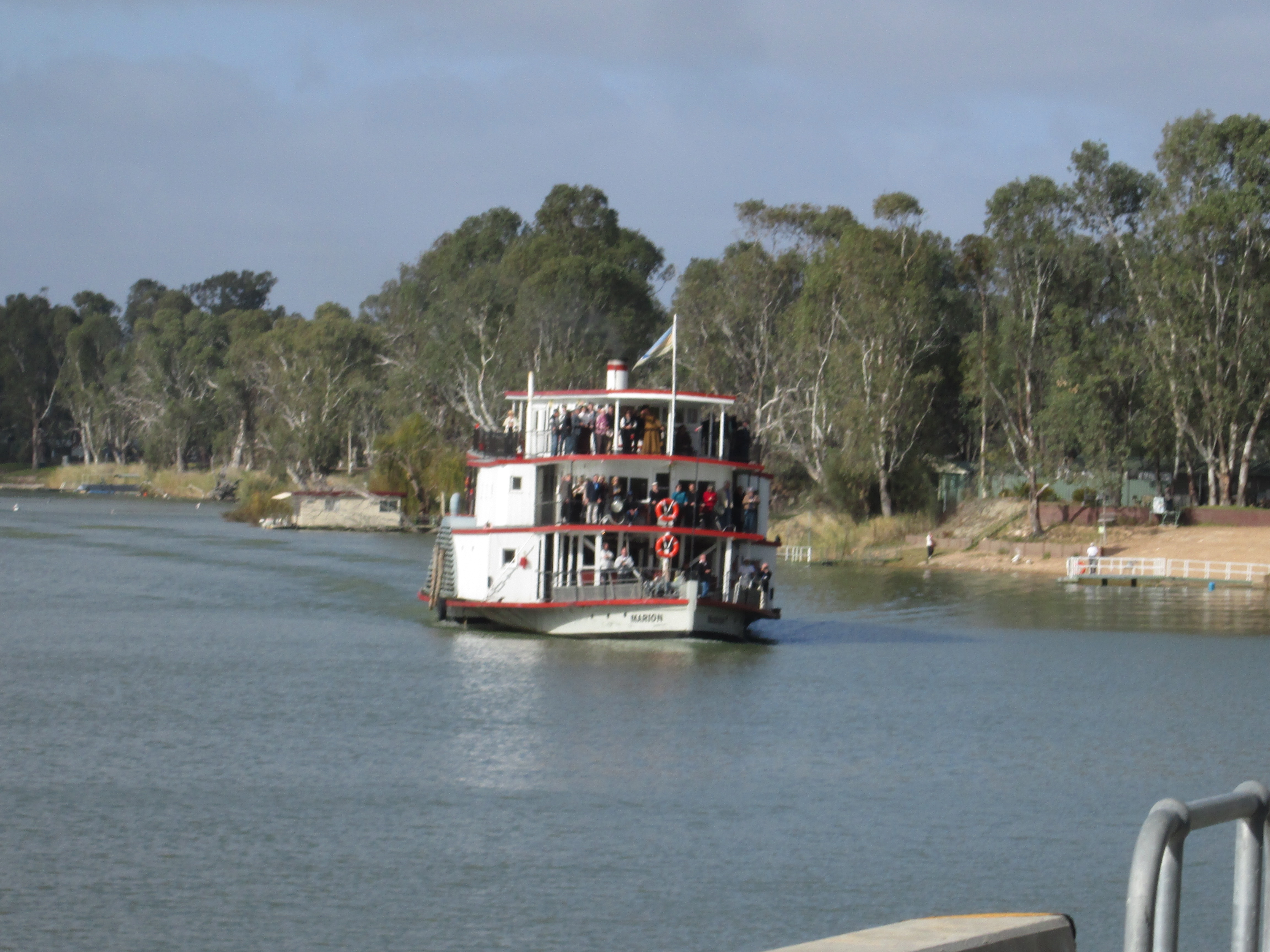
On June 5 2015, a large crowd assembled in a large marquee on the lawns at Lock 1. There were displays of historic photos of the works supplied by SA Water, the PS Marion arrived with many people in appropriate attire from years gone by, the brass band played and the school children sang. And a centenary plaque was unveiled in honour of the occasion. It was AMAZING!!

I also held a launch at State Library of South Australia, Olivewood Historic Homestead & Museum and Mildura & District Genealogical Society Inc.
It was 5 years from when I first envisaged the book to its launch in 2015 and now it’s another 10 years on.
Those I interviewed have now all passed away but their memories as well as the documentary evidence is recorded for ever. Thanks again to all those who helped me along the journey in any way. Books can be ordered from the printer: https://www.digitalprintaustralia.com/bookstore/list-all-products.html?keyword=harnessing+the+river+murray&view=category&option=com_virtuemart&virtuemart_category_id=0&Itemid=222

Helen and Hon Ian Hunter MLC
Helen and Hon Ian Hunter MLC at unveiling of centenary plaque 5 June 2015 at Blanchetown

A stroke of luck and an incredible discovery

While researching for my book, Harnessing the River Murray, Stories of the People Who Built Locks 1 to 9, 1915 to 1935, it was a stroke of good fortune that I discovered a kind of literary ‘time capsule’ containing letters from five children from one family at Lock 5. It was in “The Murray Pioneer and Australian River Record,” that I uncovered a series of letters written by the children of Arthur and Florence Rains while Arthur was employed at Lock 5, Paringa. To ‘hear the voices’ of these children over ninety years later is incredible! The five children wrote seventy-one letters between them to the weekly Young Folks Column conducted by “the Mopoke” and spoke of their time at Lock 5 camp between 1924 and 1927. This allowed me an almost tangible connection with the family as well as to the community in which they lived.
The historical records of engineering works primarily consist of the official records of the construction authorities; the insider’s view through the children’s eyes is a very rare opportunity to see the details of life at the lock camp.
If you would like to hear more about these letters and indeed of

Details of Fleurieu Peninsula Family History Group Seminar Day https://fleurieufamilyhistory.org/

the social history of the lock building communities, you may like to attend an upcoming seminar day to be held at Christies Beach, Saturday August 17. Details in the image. Bookings essential.

My book will be available for sale on the day.

One year since the centenary celebrations

Last year, this day was marked by a large gathering at Lock 1 at Blanchetown to re-enact the laying of the Foundation Stone signalling the start of locking the river. Just as had happened 100 years before, the PS Marion arrived carrying guests, a band played, children formed a guard of honour and speeches were made. Also my book, Harnessing the River Murray, stories of the people who built Locks 1 to 9, 1915-1935, was officially launched.

The centenary plaque, Blanchetown.

The centenary plaque, Blanchetown.

The Murray Pioneer wrote of the Foundation Stone event back in 1915, as follows:1915 06 03:
A stone to mark the site of the first lock in South Australian territory will be laid by the Governor (Sir Henry Galway) next Saturday afternoon (June 5th). A large Parliamentary party will leave Adelaide on Friday evening for Murray Bridge, where they will go aboard the S.S. “Marion”, which is being especially fitted up for the occasion under the supervision of the Chief Engineer of the Gem Navigation Company (Mr. Fuller). Including the crew, there will be over 120 passengers on the boat, which will be the home of the party till the following Monday morning, when a special train for the city will be boarded at Goolwa. The Prime Minister (Mr. Fisher) and Mr. Holman (Premier of New South Wales) are expected to be members of the party and to speak at the stone laying function. This is timed to take place at 2 p.m., but a glance at the timetable indicates that it may possibly be later. Parties from Renmark and Loxton will probably motor to Blanchetown to witness the ceremony. As the first lock is to be called the William R. Randell lock, it is fitting that Captain Randell [W. R’s son, who was chief engineer and water master for the Renmark Irrigation Trust] should be among those going from Renmark.

The Marion steams into Lock 1, June 5, 2015

The Marion steams into Lock 1, June 5, 2015

Happy New Year!

CaptureWhat a fabulous year 2015 has been, celebrating the centenary of lock building on the Mighty Murray. So grateful that my years of research and writing finally came to completion with the publication of the history which pays tribute to the men and women whose lives and work led to the accomplishment of this great engineering feat.
Thanks to all who have supported my work in any way and to those who have purchased a copy of the book. My life has been greatly blessed by meeting so many wonderful people. Happy New Year everyone!

Christmas 1924 at Lock 9 camp

lock 7 Christmas tree from dawn glenn collection

This tree at Lock 7 depicts a similar one to what the community would have put up at Lock 9 years earlier.

On December 13, a heatwave of above 100 degrees F came to an end when about an inch of rain fell, a steady soaking rain.
On Monday December 8, the Georgian vaudeville company visited the camp and a reasonable attendance enjoyed the entertainment. On Wednesday December 10, a concert organised by Tom Irvine was given before a crowded house, the proceeds being in aid of the children’s Christmas tree and sports. A varied and entertaining program consisted of an overture by Connie Reed, songs by Mrs Florence Reed and Mrs Mary Grosse, duets by the Gorman and Reed girls, quartets by Misses Gorman and Messrs Gorman and Bowell, songs by the schoolchildren and comic items by Bertie Pearson and Bertie Bowell, violin and mandolin numbers by Albert Charlton and songs by Arthur Gorman. A dance followed.

On Christmas Eve, a wonderful Christmas tree was arranged for the children. The tree was erected on the lawns adjacent to the men’s quarters and it was decorated with toys, balloons and Christmas stockings. The many little electric bulbs illuminated the tree amid the surrounding darkness. Father Christmas, (Oliver Edwards) arrived by car and the children excitedly greeted him as he proceeded to distribute the toys. 122 children received a toy and stocking each. A plentiful supply of fruit, lollies, and cool drinks was provided. Mr. and Mrs. Albert Charlton provided music with piano and violin and there was plenty of dancing and games.

1931 Christmas: Charlie’s Toby jug

“On the way, I got out at Blanchetown and spent Christmas with my cousins, the Brooks family. This little Toby Jug was my present off the Christmas tree in 1931. That’s all we’d get, one present. I arrived on Christmas Eve and the parents were given a present for each child and all that was left on the tree was a little Toby Jug.” (Page 153 Harnessing the River Murray: stories of the people who built Locks 1 to 9, 1915-1935)
charlies toby jug 1931 Christmas 4

In 1931 they had the big flood and they urgently needed stone so I was able to go with my father on the PS Captain Sturt because it was school holidays. On the way down, they had a barge on each side and one in front as well as the big 90-foot derrick boat, with the big boom on it. We had to take it down to Lock 2 to stand the trestles in the navigable pass up again after the flood.
We couldn’t travel at night in case we ran up a billabong because the river was up. On the way, I got out at Blanchetown and spent Christmas with my cousins, the Brooks family. This little Toby Jug was my present off the Christmas tree in 1931. That’s all we’d get, one present. I arrived on Christmas Eve and the parents were given a present for each child and all that was left on the tree was a little Toby Jug.
The boat went down and got a load of stone and picked me up on the way back. Coming back we couldn’t travel at night because the river had dropped so much, we were frightened of running against a sandbar. And we just got through past Lock 6 nearly to the South Australian border when we ran aground. Then we were two days while the men had to go back in a rowboat to Lock 6 and help get the weir back into place to build the river up so we could get moving again. The trip could take about three to four weeks I suppose, long enough for the school holidays to pass. By the time we got back it was time to go back to school again.

Harnessing the River Murray: stories of the people who built Locks 1 to 9, 1915-1935 by Helen Stagg

Featured

You can preview the book on this link:

The book, with a foreword by Professor Geoffrey Blainey, has 258 pages and over 150 photographs.

The book, with a foreword by Professor Geoffrey Blainey, has 258 pages and over 150 photographs.

SAMPLE-Harnessing_the_Murray


Books can be ordered on-line or by phone from Digital Print, Adelaide. You can arrange to collect the book from their city address if you prefer. (You would need to telephone to arrange this: Freecall – 1800 970 971

Click here for your on-line order from Digital Print


Rest in peace Maxwell George Pearson

Max Pearson, who has inspired much of my work on researching lock and weir construction history, passed away a week ago; a man with a kind and generous heart and a passion for the River Murray, with always a story of life in the lock camps to share. He will be greatly missed.

Max Pearson sharing a story from lock-building days.

Max Pearson sharing a story from lock-building days.

My association with Max began in 1998, when I telephoned him in response to an advertisement placed by a committee he had formed to arrange a reunion of lock-builders’ families. (I had intended to take my mother whose father was also a lock-builder.) My initial phone call to Max alerted me to his passion to tell the stories of the transient lock-building communities. Reflecting on this conversation ten years later, Max seemed a very suitable subject for my Oral History Unit interview, which was part of my Masters in History program in 2009.

After the initial interview and project, I was inspired to pursue my research on the subject of lock and weir construction, and Max put me in touch with others who would have memories to share.

The friendship with Max developed over the years as I undertook the writing of a book, Harnessing the River Murray, the stories of the people who built Locks 1 to 9, 1915-1935, due for release on 5 June 2015, the centenary of the foundation stone for Lock 1 at Blanchetown.

I enjoyed many conversations and phone calls with Max.When my archival research threw up a question, I would ring Max and get an eye-witness answer if I could.

On several occasions, I met Max at Lock 7 site, where the little township once stood during lock construction, and he would point out the locations of the various parts of the camp, the school, the oval, the houses etc.

Max Pearson loved the Murray River and its history. He treasured its presence in his life, and I treasure the memories I hold of Max and our shared love of Lock and weir construction history. Thank you Max! RIP.

Evelyn Rains: My Inspiration

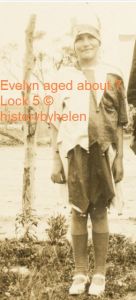
I owe my fascinEvelyn Rains aged about 7ation in Lock history to the stories my mother Evelyn told me when I was growing up about her childhood on the various locks where her father worked during construction. When the family were living at Lock 5, Evelyn and her brothers and sister wrote letters to the Children’s Column in the Renmark paper.One of them is attached for you to read, (1926 08 31) Today would be her 96th birthday and I honour her memory and the passion she instilled in me about our shared heritage.

1926 08 31 Murray Pioneer Evelyn