10 years since the launch of “Harnessing the River Murray: Stories of the People who Built Locks 1 to 9: 1915-1937” by Helen Stagg

10 years ago today,”Harnessing the River Murray: Stories of the People Who Built Locks 1 to 9. 1915-1935″ was launched. I am not sure if you know what was involved in the writing, or how it evolved so here goes:
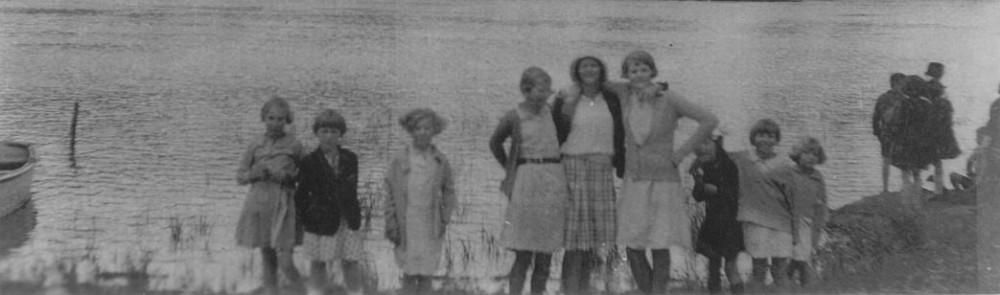
As a child, I was frequently told stories by my mum of her younger days growing up in the lock camps where her father was employed as an engine driver. He had spent almost 20 years on the works, from Lock 1 to Lock 5, then Lock 6 and finally Lock 7, before finally moving the family to Mildura on the completion of Lock 7. Over several years, I had been in touch with Max Pearson, of Waikerie, also a child in lock construction days, and discovered his passion that the history be told and recorded. So it was, that when I was undertaking my Masters in History, I interviewed Max as part of an Oral History project before writing my final Masters submission on the lock history. I was hooked!!

I had already invested a lot of time and developed a passion too to tell the little-known stories of families whose lives were lived in extraordinary conditions on the banks of the Murray at various locations. So when I realised at the end of my Masters, that in 5 years time, it would be 100 years since the great scheme began at Blanchetown in South Australia with the laying of the Foundation Stone on 5 June 1915, the duty fell to me to bring together the history in the form of a book. I wanted to commemorate the unsung men, women and children, who together with great engineers and relatively simple steam driven machinery like derricks, flying foxes and pile drivers, harnessed the Mighty Murray.

Max Pearson put me in touch with others in Adelaide who had also grown up on the locks, and I had contacts too in Mildura where I was living. I interviewed these people on several occasions, and a few of them (Max, Charlie Adams and Thelma McGair) were ‘frequent companions on my writing journey’ as I would phone or visit again and again to investigate some new aspect of the history that I had discovered at the State Records of South Australia. I also interviewed Murray Brooks, Ian McPhee, Marjorie Francis and Phillis Pickering, and used my mother’s memoir as well.
I made many trips to Adelaide to utilise the Engineering and Water Supply Department records at SRSA and also to Melbourne to the Public Record Office Victoria for the Education Department records for schools at Lock 7 and Lock 9 which were supplied with a teacher by the Victorian Education Department.

Slowly it all came together. The Murray-Darling Basin Authority together with SA Water organised a re-enactment of the 1915 Foundation Stone Ceremony at Lock 1 on June 5 2015 and the opportunity for my book launch.

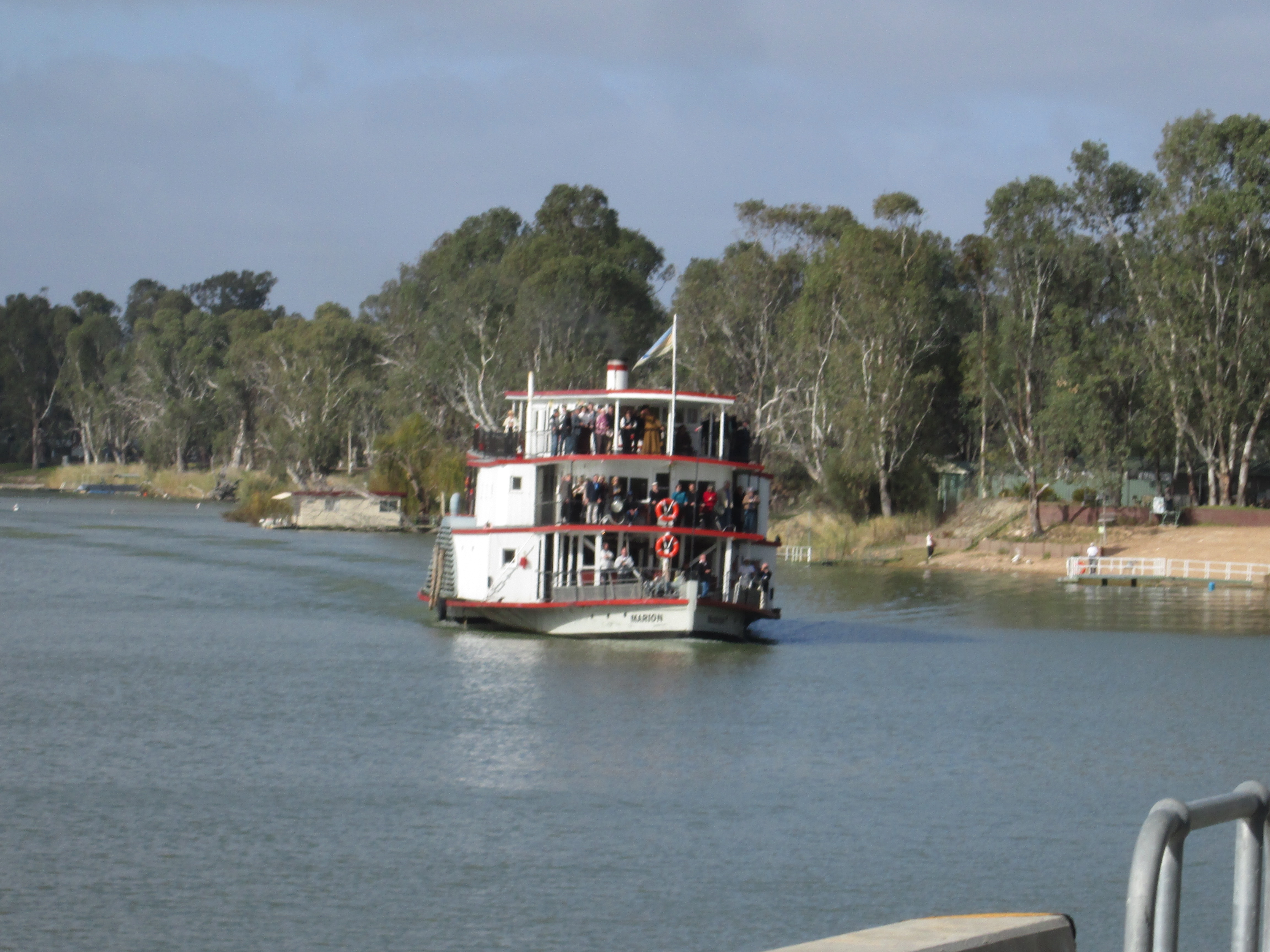
On June 5 2015, a large crowd assembled in a large marquee on the lawns at Lock 1. There were displays of historic photos of the works supplied by SA Water, the PS Marion arrived with many people in appropriate attire from years gone by, the brass band played and the school children sang. And a centenary plaque was unveiled in honour of the occasion. It was AMAZING!!

I also held a launch at State Library of South Australia, Olivewood Historic Homestead & Museum and Mildura & District Genealogical Society Inc.
It was 5 years from when I first envisaged the book to its launch in 2015 and now it’s another 10 years on.
Those I interviewed have now all passed away but their memories as well as the documentary evidence is recorded for ever. Thanks again to all those who helped me along the journey in any way. Books can be ordered from the printer: https://www.digitalprintaustralia.com/bookstore/list-all-products.html?keyword=harnessing+the+river+murray&view=category&option=com_virtuemart&virtuemart_category_id=0&Itemid=222

Helen and Hon Ian Hunter MLC
Helen and Hon Ian Hunter MLC at unveiling of centenary plaque 5 June 2015 at Blanchetown

One year since the centenary celebrations

Last year, this day was marked by a large gathering at Lock 1 at Blanchetown to re-enact the laying of the Foundation Stone signalling the start of locking the river. Just as had happened 100 years before, the PS Marion arrived carrying guests, a band played, children formed a guard of honour and speeches were made. Also my book, Harnessing the River Murray, stories of the people who built Locks 1 to 9, 1915-1935, was officially launched.

The centenary plaque, Blanchetown.

The centenary plaque, Blanchetown.

The Murray Pioneer wrote of the Foundation Stone event back in 1915, as follows:1915 06 03:
A stone to mark the site of the first lock in South Australian territory will be laid by the Governor (Sir Henry Galway) next Saturday afternoon (June 5th). A large Parliamentary party will leave Adelaide on Friday evening for Murray Bridge, where they will go aboard the S.S. “Marion”, which is being especially fitted up for the occasion under the supervision of the Chief Engineer of the Gem Navigation Company (Mr. Fuller). Including the crew, there will be over 120 passengers on the boat, which will be the home of the party till the following Monday morning, when a special train for the city will be boarded at Goolwa. The Prime Minister (Mr. Fisher) and Mr. Holman (Premier of New South Wales) are expected to be members of the party and to speak at the stone laying function. This is timed to take place at 2 p.m., but a glance at the timetable indicates that it may possibly be later. Parties from Renmark and Loxton will probably motor to Blanchetown to witness the ceremony. As the first lock is to be called the William R. Randell lock, it is fitting that Captain Randell [W. R’s son, who was chief engineer and water master for the Renmark Irrigation Trust] should be among those going from Renmark.

The Marion steams into Lock 1, June 5, 2015

The Marion steams into Lock 1, June 5, 2015

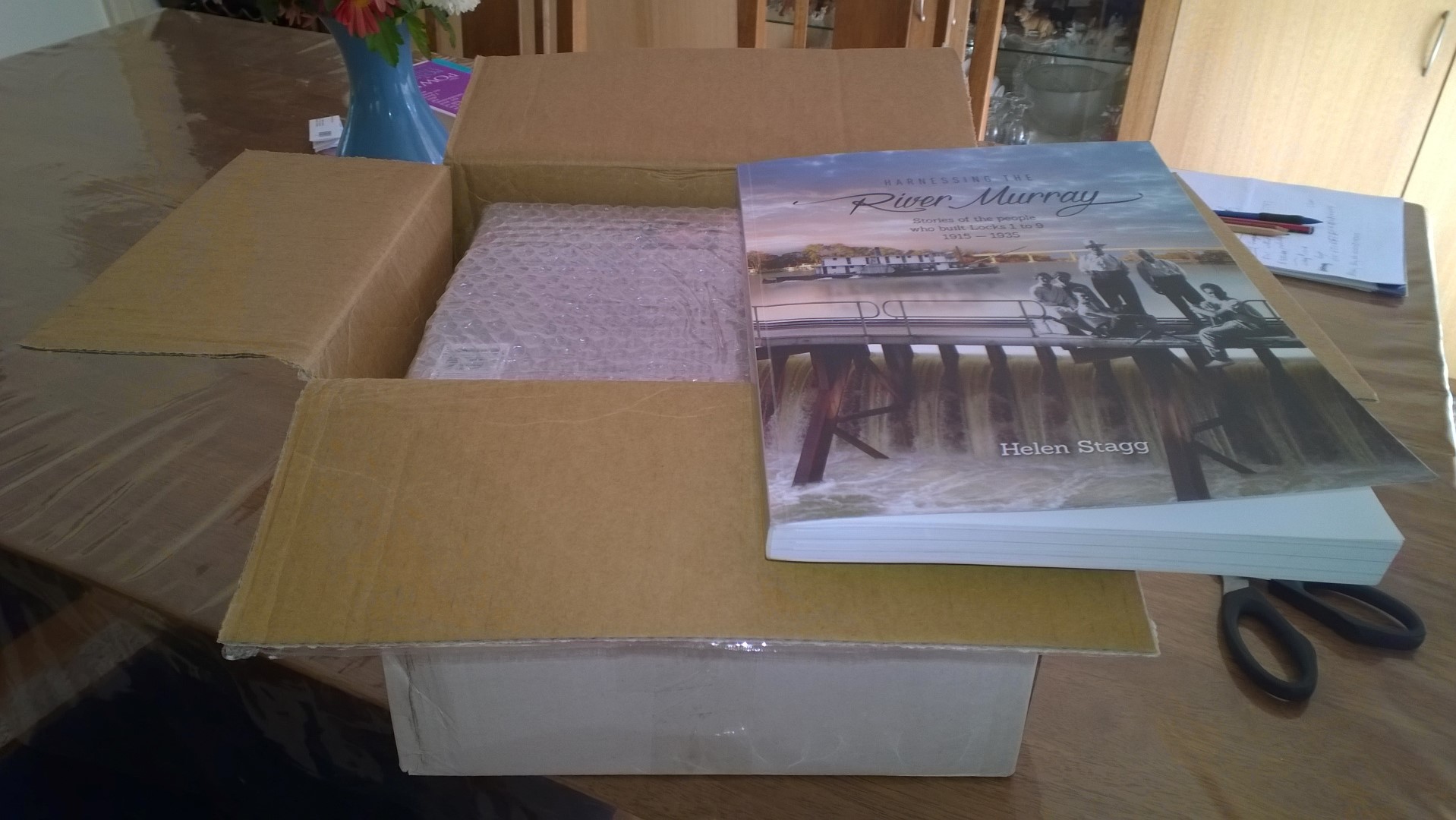
Great summer holiday reading.

IMG_6824

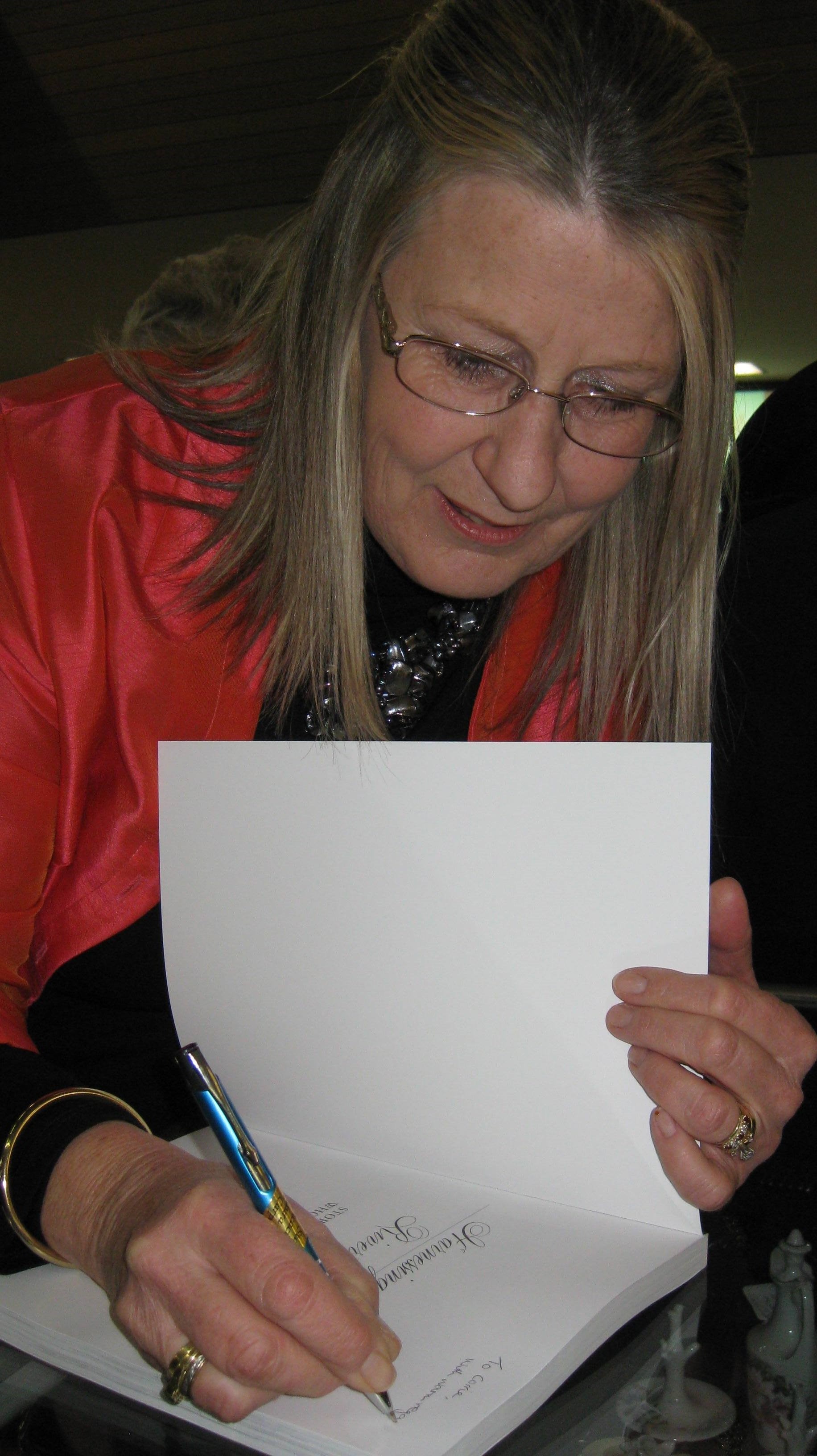
Author and historian Helen Stagg signing a copy of her newly released social history of the Lock construction workers at one of the Book Launches in 2015.

Retail outlets: Harnessing the River Murray, Stories of the people who built Locks 1-9. 1915 to 1935, by Helen Stagg. (RRP $44.95)

Adelaide: Digital Print, Print on Demand, 135 Gilles St Adelaide, 08 82323404 Order here!

Mildura: Book City, 58 Langtree Avenue Mildura Mildura Visitor Information Centre.

Echuca: Murray River Paddlesteamers, 57 Murray Esplanade, Port of Echuca
Mannum: Mannum Dock Museum and Information Centre, 6 Randell Street.

Renmark: T H Books 173 Murray Street Renmark & Olivewood Museum

Swan Reach: Swan Reach Museum, 22 Nildottie Road, Swan Reach, SA. Phone 08 85702019

Wentworth: Clarkes Newsagency, 55 Darling Street, Wentworth

Harnessing the River Murray

1931 Christmas: Charlie’s Toby jug

“On the way, I got out at Blanchetown and spent Christmas with my cousins, the Brooks family. This little Toby Jug was my present off the Christmas tree in 1931. That’s all we’d get, one present. I arrived on Christmas Eve and the parents were given a present for each child and all that was left on the tree was a little Toby Jug.” (Page 153 Harnessing the River Murray: stories of the people who built Locks 1 to 9, 1915-1935)
charlies toby jug 1931 Christmas 4

In 1931 they had the big flood and they urgently needed stone so I was able to go with my father on the PS Captain Sturt because it was school holidays. On the way down, they had a barge on each side and one in front as well as the big 90-foot derrick boat, with the big boom on it. We had to take it down to Lock 2 to stand the trestles in the navigable pass up again after the flood.
We couldn’t travel at night in case we ran up a billabong because the river was up. On the way, I got out at Blanchetown and spent Christmas with my cousins, the Brooks family. This little Toby Jug was my present off the Christmas tree in 1931. That’s all we’d get, one present. I arrived on Christmas Eve and the parents were given a present for each child and all that was left on the tree was a little Toby Jug.
The boat went down and got a load of stone and picked me up on the way back. Coming back we couldn’t travel at night because the river had dropped so much, we were frightened of running against a sandbar. And we just got through past Lock 6 nearly to the South Australian border when we ran aground. Then we were two days while the men had to go back in a rowboat to Lock 6 and help get the weir back into place to build the river up so we could get moving again. The trip could take about three to four weeks I suppose, long enough for the school holidays to pass. By the time we got back it was time to go back to school again.

SA’s Best Kept Secret: Swan Reach Museum, South Australia.

Swan Reach Museum 22 Nildottie Road, Swan Reach SA

Housed in the old Swan Reach school building built in 1917 using stone cut from the cliffs along the River Murray, the museum is a must see. It has a comprehensive historical display complemented by a well-stocked shop with books including the recently published ‘Harnessing the River Murray: stories of the people who built Locks 1-9, 1915 to 1935.’

The museum’s significant collection includes Aboriginal artefacts, agricultural and domestic equipment from a farm in the Galga area and other fascinating memorabilia from bygone eras.

Take the path outside and more intrigues from the past await. Of special importance is a purpose-built shed dedicated to telling the history of Lock 1 and the ferries in the district. Included in the display are two vintage engines once used on the ferries, old machinery, tools and wooden patterns used to cast the steel ferry wheels, as well as a large photographic collection of the ferries in the district and the construction of Lock 1.
Next is a small blacksmith shop made from old native pine and flattened tar drums which houses a collection of blacksmith tools and one wall is dedicated to a collection of rabbit and dingo traps.

You will also find an old telephone exchange building, containing one of the State’s last manual telephone switchboards, and a sound proof box used to send and receive telegrams via Morse code. From here the path, lined with rose bushes, passes old farming implements from the district leading back to the museum’s entrance.

Take time to browse in the store there and support the small band of volunteers who work hard to keep our history alive.
Location 22 Nildottie Road Swan Reach, South Australia 5354
Wednesday 2 pm – 4.30 pm. Saturday 10 am – 12 noon or by appointment
Phone 0885702019 or 0885702223 for more information or if you would like to purchase a copy of ‘Harnessing the River Murray: stories of the people who built Locks 1-9, 1915 to 1935.’ Your purchase will support the work of the museum.

Swan Reach Museum, 22 Nildottie Road, Swan Reach, SA. 0885702019

Swan Reach Museum, 22 Nildottie Road, Swan Reach, SA. 0885702019

Harnessing the River Murray: reader feedback.

It has been very satisfying to receive letters from those who have read my book. Here are some of the comments:

“Well researched, presented, captivating and enlightening. I trust yourWP_20150819_005 book will become part of Australia’s historical archive.” DH
“Just want to say what an excellent work you have produced. It is most interesting to read and is so well produced. Thanks for all your hard work. It is another valuable resource document for many to enjoy.” DT
“Thank you for writing such an interesting book. I had no knowledge of the lock building other than Lock 1. I always imagined that they were built in numerical order.” RH
“It’s fascinating – a wonderful record and great read. So glad you wrote it!” PK
“Just thought that I’d let you know how much I had enjoyed your book. I especially like the illustration on p. 33 of the houseboat….So much more of interest in the book.” DW
“I really enjoyed the book. It gives a great insight into the project and its ups and downs. It would have been tough times especially during the Depression.” JN
“Many thanks for the book!! I already have a line wanting to check it out!” NM, Librarian
“I have now read it and understand a lot more of the place and times.” VM
“It was a great read – I couldn’t put it down until I had finished. Thanks a lot Helen; the Lock 5 history was essential reading for my family research to find its mark. Even though it was a sad outcome, I still think it best to know the truth of the situation. Thank you again for your insightful book.” SV