Sports Day…. “Big Day Out” at the locks!

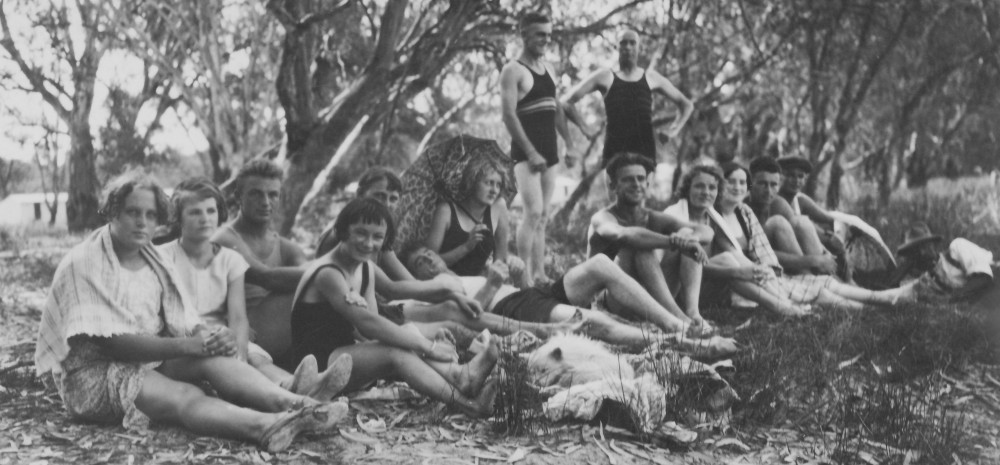
The lock camp residents knew how to have fun: school picnic lock 7 MP
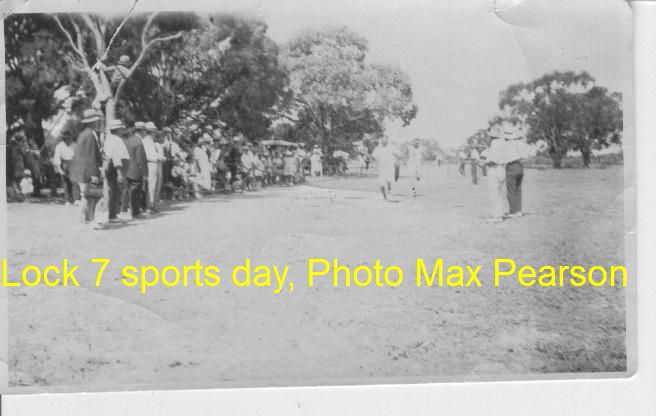
The photo depicts a sports day at Lock 7 c 1931 while the article is of a similar day at Lock 9 in 1925.

1925 01 09 Murray Pioneer and Aust. River Record:
CHILDREN’S SPORTS, Good Day and Large Attendance, Lock 9, January 1, 1925.

The local children’s sports were held on the sports ground on Monday, December 29, and favoured with a perfect day. A large number of people gathered and witnessed a good day’s sport. A lengthy programme was provided and all events were keenly contested. The ladies especially entered into the spirit of the day, making it necessary to run all their events in heats.
The officials in charge of the day’s proceedings were: judges Messrs B Bowels, C Reed and A Blake; handicappers, Messrs J Scott, and W Cuy, starters: Mr W Sandy and L Rogers. Committee: Messrs T Satterthwaite, Chairman, G Brooks, W Cuy, J McPhee, C Adams O J Edwards, A Charlton, Secretary W J O’Donnell. Ladies’ committee consisting of Mesdames Cuy, Charlton, McPhee, Edwards, O Donnell, Eddy and Miss Hawkes had charge of the refreshments.
The day’s proceedings went without a hitch and the way all present helped speaks volumes for the good spirit existing between the residents of lock nine. The results of the day were as follows: –
Boy’s race: under five, C McPhee 1, I McPhee 2
Girls under 5: E Bowden 1, B Charlton 2
Girls under 7: M Brooks 1, R Bornholm 2
Girls 5 to 7: Lorna Brooks 1, Alice Peters 2
Boys 7 to 10: N Ashton 1, P Reed 2
Girls 7 to 10: Audrey Brooks, 1 Myra Pelgrave 2
Girls 10 to 14: P Rogers 1, A Pearson 2
Boys 10 to 14: E Sherlock 1, R Edwards 2

Putting tail on pig: A Peters 1, K Reed 2
Girls’ Siamese race: A Pearson and P Rogers 1, A Brooks and M Pelgrave 2
Boys’ Siamese: T Edwards and H McPhee 1, T Gorman and G White 2
Single ladies: N Reed 1, G Hawkes 2
Men’s Sheffield: W Cuy 1 F Satterthwaite 2 J McPhee 3
Ladies’ wheelbarrow: Mrs Wilson 1, Mrs Bornholm 2, Mrs White 3
Thread the needle: Girls: A Pearson 1, N Reed 2.
Thread the needle: Ladies: Miss G Hawkes 1, Mrs McPhee 2
Boys’ Sheffield: R Edwards, 1 K Brooks 2, B Reed 3
Boys’ hurdles: E Brooks 1, R Edwards 2, B Reed 3
Men’s hurdles: J McPhee 1, T Bornholm 2, W Cuy 3
Men’s obstacle: M Rogers 1. W Bowden 2
Boys’ obstacle: R Edwards 1, E Brooks 2
Married ladies’ race: Mrs Cuy 1, Mrs Strachan 2, Mrs Eddy 3
Girls’ Potato race: A Pearson 1, T Reed 2
Old Buffers: O Edwards 1, T Bornholm 2.
Ladies’ nail driving: Mrs McPhee 1, Mrs Bath 2
Throwing at wicket: Ladies Mrs Bowden
Boys’ high jump: R Edwards 1, E Brooks 2
Men’s hop step and jump: J McPhee 1, W Cuy 2
Ladies’ catching rooster: Miss Clara Gorman
Boys’ consolation: B Reed 1, H Reed 2
Girls’ consolation: N Raines 1, R Scott 2
Ladies’ Cotton winding: Mrs O’Donnell 1, Mrs Ashton 2
Stepping the distance: C Reed, A Eddy, O Edwards
440 yards handicap: F Satterthwaite 1, W Bowden 2
Ladies’ committee race: Mrs Cuy 1 Mrs Eddy 2 Mrs McPhee 3
Men’s committee race: B Bowels 1, W Sandy 2.
In this race the judging, handicapping and starting was carried out by the ladies.

Bush Telegraph on Radio National, 15/08/2014 11.30 am.

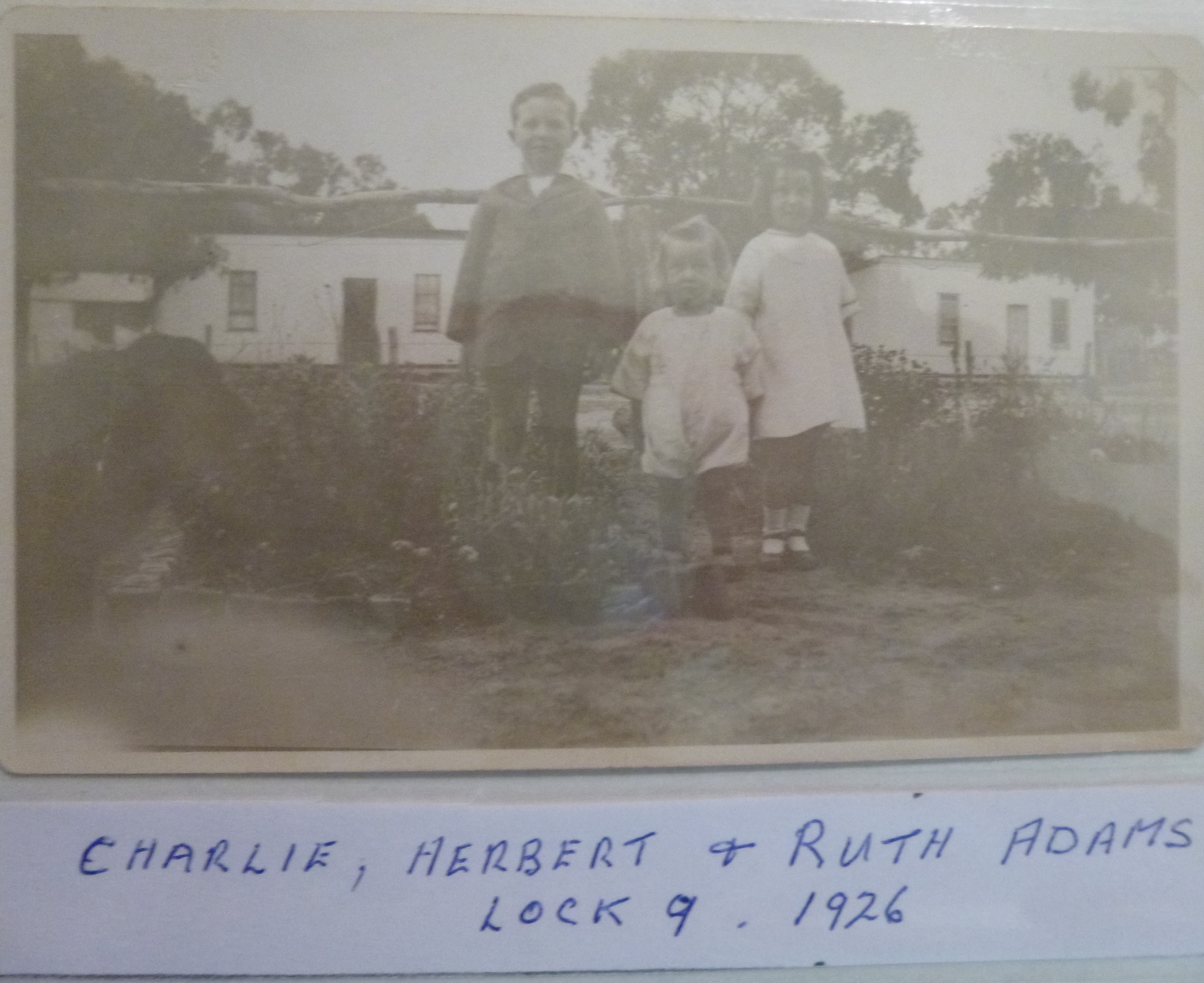
It will be an honour to share an interview on Bush Telegraph with Charlie Adams tomorrow. Charlie is one of my initial oral history interviewees who spent his entire childhood growing up on the lock construction communities. He was about 2 years old when his parents moved from Broken Hill to the works at Blanchetown South Australia. This job was to take the growing family from there to Lock 9, followed by Lock 4 and then Lock 7.
Charlie has some great memories especially of Lock 7.

Charlie, Herbert and Ruth Adams, Lock 9 1926.

Charlie, Herbert and Ruth Adams, Lock 9 1926.

Before the harnessed river….

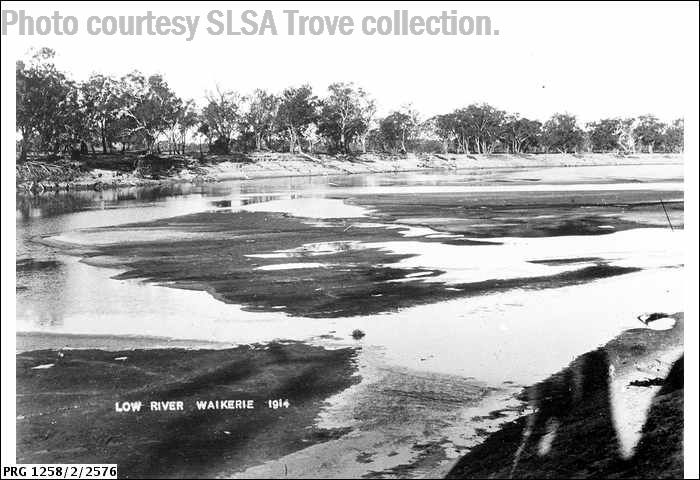
1914 Low river Waikerie

1914 Low river Waikerie

Before the Murray River was controlled by the locks and weirs, recurring low rivers sometimes reduced the river to a series of ‘waterholes.’
Even without this extreme, a drop in the height of the river made the passage of riverboats fraught with danger or even impossible. Hence the reference to the ‘open river’ in this document.

1927 10 18 SRSA grg53 1 unit 1057 file 1160 John Gore Stewart to the Commissioner of Public Works:
The site of Number Seven Lock and Weir has now been finalised and approved on the ground by the River Murray commission. Lock number two which has progressed very favourably is now nearing completion and it is important that the plant and temporary buildings should be transported to the site of number seven during the present open river, which will only be available for a comparatively short period. As pointed out by the Constructing Engineer in his minute of 17 October 1927, herein, if the advantage is not taken of this river, there will be a period of forced idleness, which will necessitate the discharge of a number of men until the next navigable river, and the cost of number seven would be considerably increased…..
GRG 53 16 Unit 1057 file 1160

ABC TV interest in my research:

Recently, ABC Riverland journalist, Tom Fedorowytsch contacted me to find out more about my research. After a couple of meetings, including one at Waikerie at the home of Max Pearson, a report was shown on ABC 7.30SA Friday August 8, 2014. (Max Pearson has given me a great deal of first hand information about the construction of the locks and weirs.)
The segment can be viewed at this link:
http://www.abc.net.au/news/2014-08-08/the-working-history-of-the-murray-river-locks/5659668
Max with his tomahawk blade
The image was taken at Lock 7 in 2010 when Max was showing me the approximate location of the Pearson house during the Lock 7 Construction. He is holding what may have been a tomahawk blade.

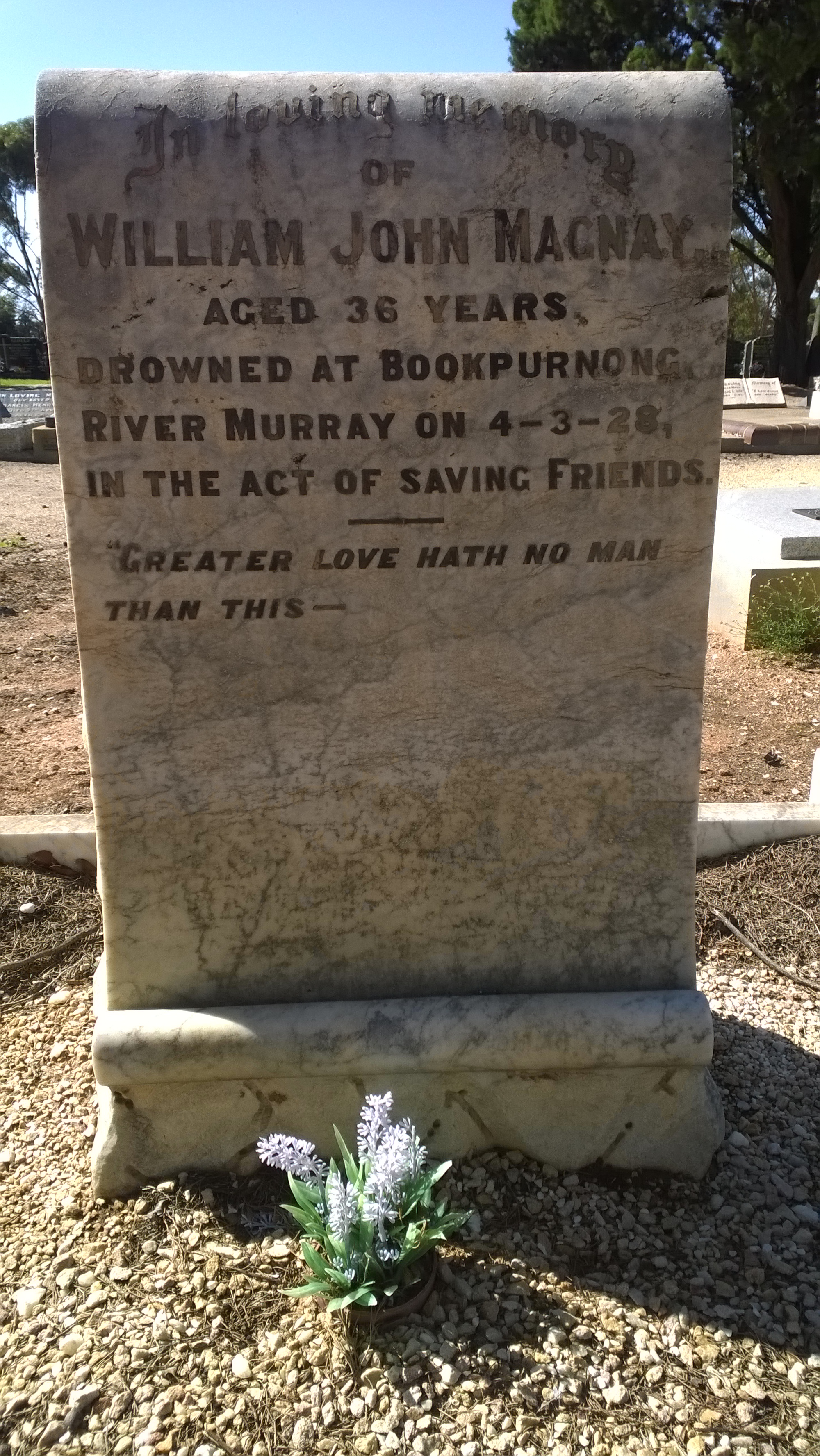
William (Billy) Magnay: Royal Humane Society Award, 1928

“The following courageous act has been recorded in the archives of the society:—William John Magnay lost his life in attempting to rescue Mrs. Barker and her child from drowning in the River Murray on March 4, 1928.” (Murray Pioneer and Australian River Record 1928 11 23)
In a gallant attempt to rescue a young girl from the river, Mr. William John Magnay, an engine man at Lock Four and an accomplished swimmer, lost his life by drowning on Sunday March 4 1928 at Bookpurnong near Loxton. The sadness of the occurrence was heightened by the fact that Mr. Magnay’s disappearance in the water was witnessed by his wife and their three little children. The body was recovered on Monday and the funeral took place at Loxton the next day at 4 pm, Mr. Turner, pastor of the Renmark Congregational Church officiating.

Mrs. Magnay, widow of the late William John Magnay, said that her husband was born in 1892 at Wandiligong, Victoria. He was an engine man, and they were married in the Presbyterian Church at Port Pirie in 1919. There were three children, Jean aged 8 years, Margaret, aged 5 years and William, aged 4 years. Mrs. Magnay said that her husband was an expert swimmer and as far as she knew he was not out of form. He loved swimming and was the last one that she would have thought would ever meet his death by drowning.

MAGNAY.—In loving memory of our dear husband and father, William John, who was drowned at Bookpumong on the 4th March, 1928.—Ever remembered by his wife and family.
MAGNAY.—In loving memory of our dear friend,2014 04 14 billy magnay loxton (2) William John, who was accidentally drowned at Bookpurnong, River Murray, on the 4th March, 1928. Greater love hath no man. —Inserted by Mr. and Mrs. A. G. Barker and family.

Magnay’s workmates at Lock 4 erected a tombstone on his grave at Loxton in February the following year, a working bee being formed for the purpose. The stone, which takes the form of a large marble scroll, suitably inscribed, is set on a concrete base surrounded by marble posts and kerbing and covered with marble chips. The employees at lock four knew that when they left Lock 4, the last resting place of the comrade they all admired and respected was adequately protected and marked for all time.

What happened to Frederick Dusker?

Renmark Hospital 1925, State Library of South Australia

Renmark Hospital 1925, State Library of South Australia


Mystery death: Dusker, Frederick Alfred who died in the Renmark Hospital Dec 31 1927 whilst employed as a labourer at Lock 6.
I wonder what caused his death? He was only 24.
His grieving mother and sister put memorium notices in the papers for several years. I have searched Trove and can find nothing else about this young man.
Can You help?
Murray Pioneer 1928 Jan 6. DUSKER—On the 31st December, at Renmark Hospital, Frederick Alfred, in his 24th year. My darling son and brother. Inserted by his mother, Mrs Ada Mills and sister Lottie Sheehan.
The father, mother and sister of the late Frederick Dusker, desire to thank the nursing staff of the Renmark Hospital, especially Sister Stevens and the little Sister on night duty attending him: also Dr. Tonkin, for their efforts to save him and their kindness generally; also Mr. T. Carter, Mrs. Sandford and family, and friends for kindness shown us, we being strangers here.

Can you help? The missing school records…

Lock 7 School c. 1931. Photo. Courtesy Max Pearson

Lock 7 School c. 1931.
Photo. Courtesy Max Pearson

The case of the missing school records: State School 4156

The many children of the lock workers at Lock 9 and Lock 7 were educated at specially provided schools on site, as was the case at the other lock sites. The peculiarity of these schools is that they were set up for the children of a largely South Australian workforce, but in Victoria. The school records which would provide insightful data for my research have not been found, either at the Public Records Office in Melbourne, where they should rightly be or at State Records South Australia. Do YOU know where they are? Could they be in a box in a shed or back room at your house?

From January 30 1923, School No. 5161 was staffed at Lock 9 River Murray by the Victorian Education Department. Mr Arthur Burgess was the first teacher. The school remained open for the duration of the lock construction at that site until August 1926 when the building was dismantled and transferred to the site of Lock 4 construction in South Australia. The head teacher at the time of closure received instructions from the Education Department of Victoria to communicate with the Head Teachers of the Werrimull and Lake Cullulleraine schools and advise them of the equipment in the school which would not be required when the school was closed. The equipment, it was suggested, could be divided between these two schools.

On February 21 1927, it was officially announced that School 4156 No. 9 Lock, Murray River was closed.  While the students then continued their education at the Lock 4 school, School No. 4156 was later ‘re-incarnated’ at the site of Lock 7, from January 1930. Once more, construction was taking place on Victorian soil, or at least the camp of the workers and their families was on Victorian soil! Construction of course was taking place in the River!

When the lock building was completed at Lock 7 at the end of 1934, the teachers were again advised to pack up the materials. The Head Teacher was informed that the departmental books received by him for State School 4156, Lock 7, were to be forwarded to the store. He was given detailed instructions for the books to be packed in a box. The maps then, should be carefully tied together and covered with hessian and rolled in a bundle. These should be consigned to the Education Furniture Depot 459 Lygon Street Carlton.

If you know someone who attended either of these schools during this period, or who taught at them or any of the other temporary schools at the lock construction sites, please contact me.

On this day, 1921

On this day in 1921 John Gore Stewart, South Australia’s Engineer in Chief stated that the navigable period on the River Murray had now practically terminated.  If there were no further interruptions the work on number one lock should be completed in a few months time and  it would be necessary to decide which lock site the ‘freed up’ plant should be transferred to.

He went on to say that as lock number five would hold up the water below Renmark, and greatly assist in irrigation by assuring water for newly established areas then being brought under irrigation, he recommended that this lock be the next one to be put in hand when number one was completed. 

Of course Lock 3 and Lock 9 would proceed simultaneously as planned. A large amount of the necessary plant had already been obtained for those two sites.

Lock 5 taken by Helen Stagg 2012 (Copyright)

Lock 5 taken by Helen Stagg 2012 (Copyright)

Weather extremes and working on lock construction.

IB63241_91 Lock 9 slsa Sheahan collectionmagine working in a drained section of riverbed on a day like today almost one hundred years ago. The steam coming off the muddy riverbed and the sheer hard work on an 8 hour shift! No shade, no protective gear, save a pair of rubber boots!! NO air conditioner to look forward to at the end of your shift, not even an icy beer! Home to your tin or canvas abode for some rest if you could get it in the scorching heat.  The attached photo is from TROVE, State Library South Australia Collection, part of the Sheahan Collection. Notation says it was taken at Lock 9. The relative size of the built structures and the miniscule men, help to tell the story.