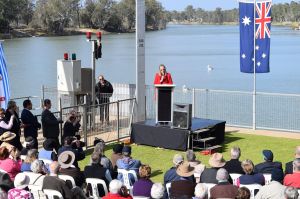
Helen Stagg’s speech at Blanchetown 5 June 2015.
(You can read the text below or click the link above to watch speech on You Tube.)
The Hon Ian Hunter, Mr Tony Pasin, Mr Neil Andrew, Mayor Dave Burgess, descendants of lock builders, Ladies and Gentlemen, girls and boys. Thank you all for being here to acknowledge the importance of this day to our history. Quite a number of you have travelled long distances and I thank you sincerely.
We all have an attachment to the Murray River although we may be unable to articulate it. Dr Paul Sinclair, in his environmental and cultural history book titled ‘The Murray’, states, ‘Memory and emotional attachment, are as much a part of the Murray, as fish, irrigation and flood.’ In my book ‘Harnessing the River Murray,’ memory and emotional attachment to the Murray play a big part and are reinforced by my extensive archival research.
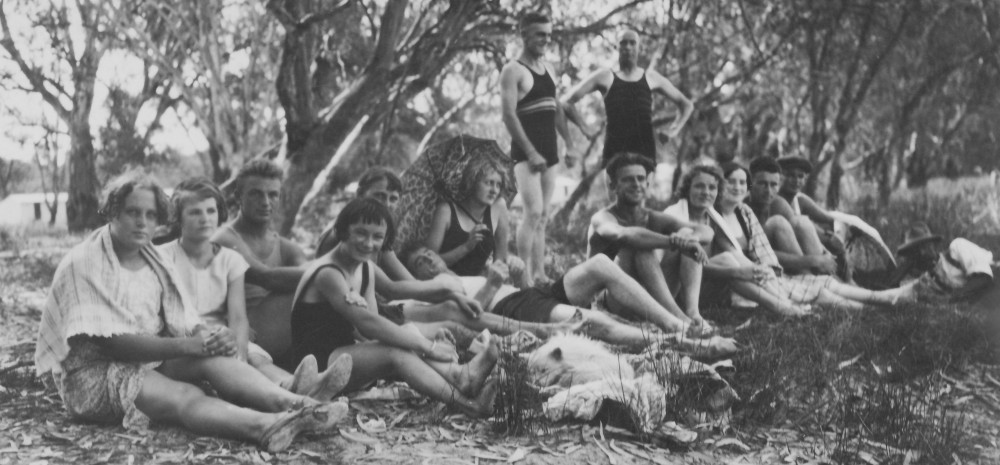
My journey towards writing this book has been long and winding, much like the river which threads its way through the text. About one hundred years ago, my grandfather, Arthur Rains, started work here at Lock 1, along with his brother Ernest, and their families. My mother Evelyn used to tell me stories of her childhood in the different lock construction camps as her family moved from one to the next. As a historian, I knew the importance of my mother’s memories, and I asked her to write them down. One story involved my mother of a child of about four, fishing with her mother Florence, here at Lock 1. Back then, Murray cod were common catches, and on that occasion, my grandmother hauled in a 50 pound whopper. In order to stop it squirming back into the river, she quickly sat on it and little Evelyn was sent home to get her father, calling out as she ran, ‘Come quickly Daddy, Mummy’s caught a whale’. During the Depression years at Lock 7, when the lock workers were placed on ‘half-time work’, living conditions became tougher than usual. To raise some cash, my grandmother decided to raffle her sewing machine for threepence a ticket and my mother recalled feeling humiliated as a 12 year old, selling the tickets in the tiny camp to their friends and neighbours.
My book-writing journey finally commenced when I met Max Pearson, the child of lock builder Bertie Pearson, who started work here at Lock 1, in 1918. Over my years of research, Max Pearson’s passion for the history of the locks, has been my constant inspiration and he shared so much of his knowledge of those years in the lock camps. Sadly, in March this year, Max passed away. I had wanted Max to be here today and in a way he is. He used to say, ‘My roots are in the River Murray’, so I am sure in a sense he is very close by us today. I am however, glad that Max’s wife, Jan, is here today. Jan’s welcome and hospitality on my many visits to their home by the Murray near Waikerie has been much appreciated. Altogether I interviewed 8 people who spent their childhoods on the locks. One of these beautiful people is here today, Thelma McGair, whose memories and photos you will discover in the book. It was quite common for several members of one family to join the lock building gangs, and Thelma’s parents, Arthur and Eva Eddy, moved to Lock 9 about 1924 to join Thelma’s uncle. The Eddys moved from Lock 9 to Lock 4 and then to Lock 7 about 1929 before finally moving on to work at the barrages at Goolwa about the start of 1935 when works at Lock 7 were completed.
The next part of my book-writing journey involved many trips from Mildura to Adelaide to sift through hundreds of dusty boxes at the State Records of South Australia. The documentary evidence I found, reinforced the stories I had been told. The lock people almost reincarnated as their determination was written on the pages of petitions demanding better health care and schools for their children.
***
Many have supported and encouraged my years of work on this project and although I cannot name everyone, it is fitting to mention some of these: Firstly, the MDBA’s Chief Executive, Dr Rhondda Dixon, showed enthusiasm for my work, and provided welcome funding for the publication. Other MDBA staff have provided invaluable assistance, in particular Brayden Dykes for his help with the graphics and with the book’s cover design, and Megan Douglas for her communication expertise. The SA History Fund also provided support and SA Water’s brilliant librarian, Hayley Morton, allowed access to official heritage photographs. Professor Geoffrey Blainey kindly took time from his busy schedule to read the manuscript and to write the foreword. Heather Everingham of the Renmark Branch of the National Trust, and many others, provided photos which bring the stories to life. My family and friends have coped with my absence in the ‘office’ over months, which became years. Thank you for your patient understanding of the importance of this project. Merrilyn Gaulke has spent hours poring over proofs of the text and Christeen Schoepf offered the moral support of a fellow historian. Most importantly, I owe gratitude to the ‘lock children’ of the 1930s, whose childhood memories are featured in the book: Thelma McGair, Max Pearson, Charlie Adams, Murray Brooks, Marjorie Francis, Phillis Pickering and Evelyn Smith. Their legacy lives on in Harnessing the River Murray and the stories of their families, friends and neighbours, are now recorded for posterity.
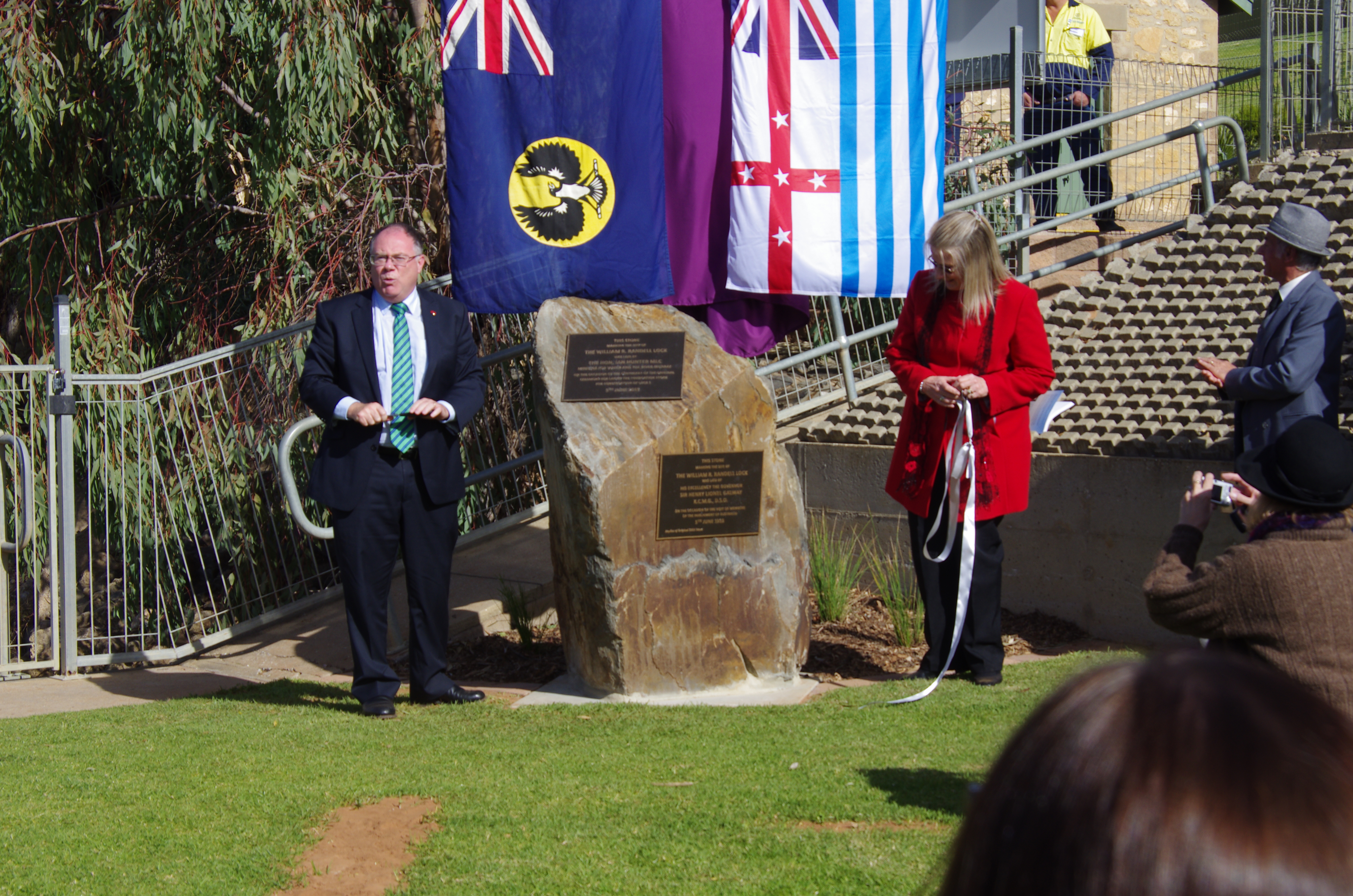
During the five years of my book writing journey, it has always been my goal to launch my book on 5 June 2015. I am grateful to SA Water and the Murray Darling Basin Authority for organising this re-enactment and providing me this opportunity to launch my book. It is fabulous to have the PS Marion and the school children present just as they were one hundred years ago, same boat, but different children! Thank you also to the lock men at Lock who have helped prepare this fabulous setting for us.
I thank you once again for attending today to remember all who were involved in harnessing the river. Without their efforts, we would not enjoy the agriculture, industry, commerce and the numerous communities in the Murray Darling Basin. As we mark the century, the responsibility rests with us, to ensure that this valuable asset, the precious waters of the River Murray, are preserved for future generations, by adopting the spirit of cooperation and determination which was so evident in the lock builders’ camps. We are the custodians of their achievements, and we honour them by entering into their history. You may find that like me, their stories will connect you more closely with the River Murray.
I trust you enjoy the read.
Books are available today and I am happy to sign them for you.

Dr Rhondda Dickson CE MDBA and historian Helen Stagg at Lock 1 centenary.
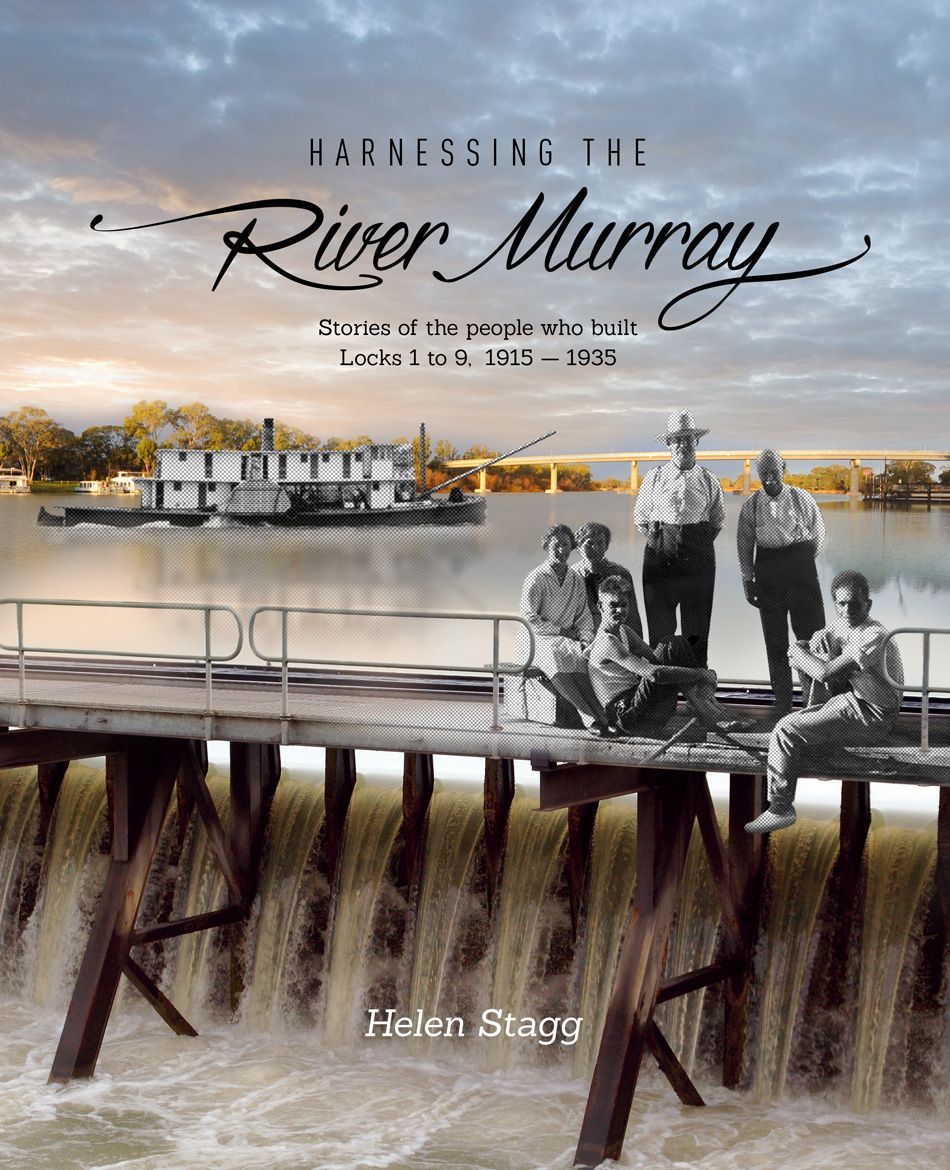
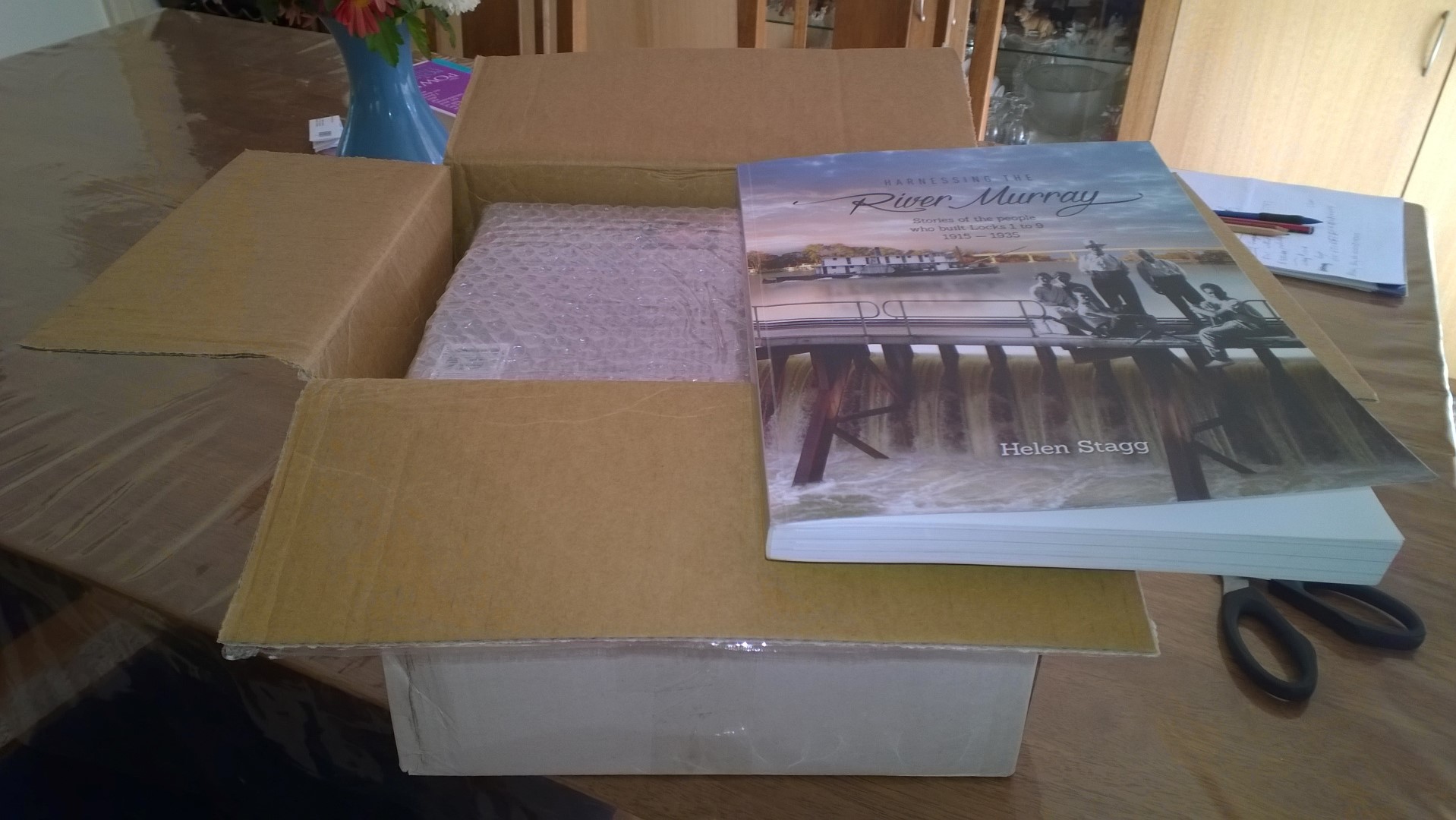
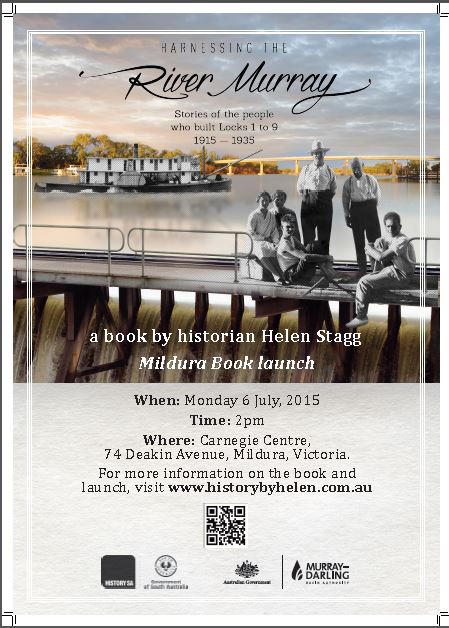
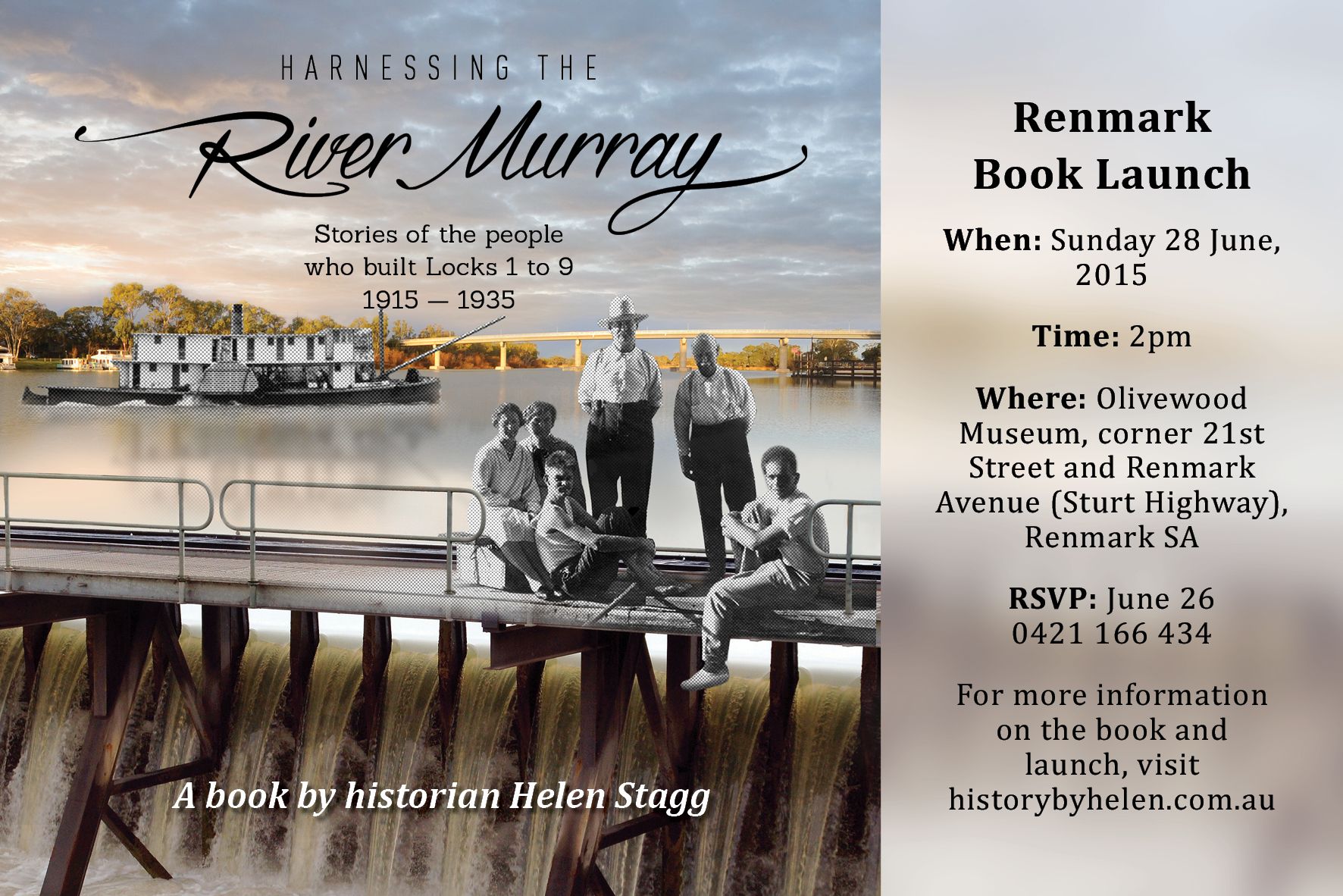
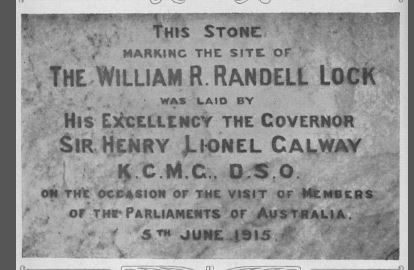
 e to control the waters of the Murray River with a series of locks and weirs. As a child Helen was told stories by her mother of her own childhood at the lock construction sites and Helen’s mission has been to further explore the stories of the workmen and their families. Over the past five years, Helen has undertaken extensive archival research and captured the oral history of some of the few remaining ‘lock children’ for her book ‘Harnessing the River Murray: Stories of the people who built Locks 1 to 9, 1915 – 1935′ which was released in June 2015. The book, with a foreword by Professor Geoffrey Blainey, has 258 pages and over 150 photographs and focuses on the first nine locks and weirs which were built by South Australia. It tells the story from the viewpoint of the ordinary people, the workers and the women and children who lived with them in the camps which popped up along the river at each construction site. 2015 marks exactly 100 years since the Foundation Stone was laid for the first Lock at Blanchetown in South Australia.









 historybyhelen
You must be logged in to post a comment.