Today I introduce my new domain name, now without the .au!!
I invite everyone to change the address in your favourites, as the old domain name no longer points to my page.
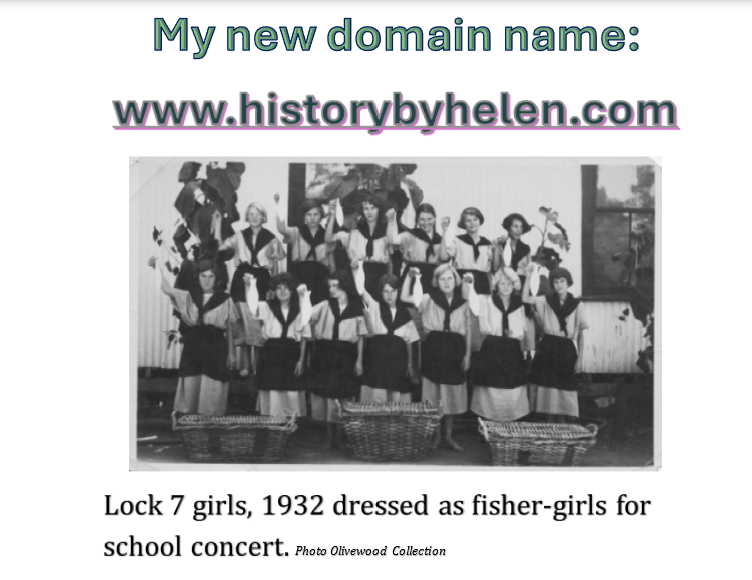
Today I introduce my new domain name, now without the .au!!
I invite everyone to change the address in your favourites, as the old domain name no longer points to my page.

10 years ago today,”Harnessing the River Murray: Stories of the People Who Built Locks 1 to 9. 1915-1935″ was launched. I am not sure if you know what was involved in the writing, or how it evolved so here goes:
As a child, I was frequently told stories by my mum of her younger days growing up in the lock camps where her father was employed as an engine driver. He had spent almost 20 years on the works, from Lock 1 to Lock 5, then Lock 6 and finally Lock 7, before finally moving the family to Mildura on the completion of Lock 7. Over several years, I had been in touch with Max Pearson, of Waikerie, also a child in lock construction days, and discovered his passion that the history be told and recorded. So it was, that when I was undertaking my Masters in History, I interviewed Max as part of an Oral History project before writing my final Masters submission on the lock history. I was hooked!!
I had already invested a lot of time and developed a passion too to tell the little-known stories of families whose lives were lived in extraordinary conditions on the banks of the Murray at various locations. So when I realised at the end of my Masters, that in 5 years time, it would be 100 years since the great scheme began at Blanchetown in South Australia with the laying of the Foundation Stone on 5 June 1915, the duty fell to me to bring together the history in the form of a book. I wanted to commemorate the unsung men, women and children, who together with great engineers and relatively simple steam driven machinery like derricks, flying foxes and pile drivers, harnessed the Mighty Murray.
Max Pearson put me in touch with others in Adelaide who had also grown up on the locks, and I had contacts too in Mildura where I was living. I interviewed these people on several occasions, and a few of them (Max, Charlie Adams and Thelma McGair) were ‘frequent companions on my writing journey’ as I would phone or visit again and again to investigate some new aspect of the history that I had discovered at the State Records of South Australia. I also interviewed Murray Brooks, Ian McPhee, Marjorie Francis and Phillis Pickering, and used my mother’s memoir as well.
I made many trips to Adelaide to utilise the Engineering and Water Supply Department records at SRSA and also to Melbourne to the Public Record Office Victoria for the Education Department records for schools at Lock 7 and Lock 9 which were supplied with a teacher by the Victorian Education Department.
Slowly it all came together. The Murray-Darling Basin Authority together with SA Water organised a re-enactment of the 1915 Foundation Stone Ceremony at Lock 1 on June 5 2015 and the opportunity for my book launch.
On June 5 2015, a large crowd assembled in a large marquee on the lawns at Lock 1. There were displays of historic photos of the works supplied by SA Water, the PS Marion arrived with many people in appropriate attire from years gone by, the brass band played and the school children sang. And a centenary plaque was unveiled in honour of the occasion. It was AMAZING!!
I also held a launch at State Library of South Australia, Olivewood Historic Homestead & Museum and Mildura & District Genealogical Society Inc.
It was 5 years from when I first envisaged the book to its launch in 2015 and now it’s another 10 years on.
Those I interviewed have now all passed away but their memories as well as the documentary evidence is recorded for ever. Thanks again to all those who helped me along the journey in any way. Books can be ordered from the printer: https://www.digitalprintaustralia.com/bookstore/list-all-products.html?keyword=harnessing+the+river+murray&view=category&option=com_virtuemart&virtuemart_category_id=0&Itemid=222


In August 2014, Charlie, aged 95 at the time, joined me in a live interview for Radio National’s Bush Telegraph Program. This was conducted by phone via the MIldura ABC studios. You can still listen to the short interview (about 12 minutes) on this link.
https://www.abc.net.au/listen/radionational/archived/bushtelegraph/lock-history/5670936


Charlie Adams took part in the oral history research for my book, Harnessing the River Murray, stories of the people who built Locks 1 to 9, 1915–1935 released in June 2015 to mark the centenary of the foundation stone for Lock 1 at Blanchetown, SA. Today I remember him and pay my respects, 9 years after his death at the age of 96.
After the Great Strike of 1919 in Broken Hill, in 1921 Charlie’s father, Charles John Adams, travelled in search of work to Blanchetown with his wife and young family. Charlie, just two years old at the time, spent his childhood moving from one lock site to the next. He lived at Locks 1, 9, 4 and 7, the locks not being built in numerical order, before moving with the family to Mildura, Victoria when Lock 7 was completed.
Although the locks and weirs have endured the ravages of time, the stories of life in the construction camps risked being lost as the last of those who were children at the locks reached a very advanced age; those I interviewed have all now passed away. This is why Charlie Adams’ mandolin story is important.
Each of the bustling, mostly remote, rural construction camps required a school and the teachers, under-resourced but assisted by parents and community members, provided a range of extra-curricular activities including music, first-aid courses, gardening programs and gymnastics training. Nella Dormer, wife of one of the Lock 7 labourers, was an accomplished pianist who played at social functions and dances and with no children of her own, she volunteered her time at the school to teach music to the students. She selected a small group of boys with special aptitude, to form a mandolin band to perform at local dances, concerts and during the silent movies. The boys were Max Pearson and George (Snowy) Taylor, aged about 10, Fred (Skinny) Bath (about 13) and Charlie Adams (12).
When I first interviewed Charlie in 2009, I was astonished when he said, ‘I’ve still got me mandolin, moth eaten by now; it’s never been out of the cupboard.’ After interviewing Charlie on several occasions, my requests to see the mandolin were met with a reticent non-committal answer along the lines of it being tucked away out of reach. It was therefore a great surprise one day when I was at his home, and he momentarily left the room, returning with an old brown case bound up with string. As he carefully placed this on the table he said to his wife, ‘Have you got your fly spray out Mum? You may want it to get the moths out!’ As the string was untied, the case literally fell open, the moths having demolished the stitching holding it together. The original music instruction booklet, the E to Z Method for Mandolin or Banjo-Mandolin lay on top of the instrument, and Charlie picked this up as a thousand memories flashed by. Then, almost reverently, he cradled the mandolin saying nostalgically, ‘Here she is. Now that’s how it was in its glory days.’ I asked him when he got the mandolin and he explained:
Mrs Dormer, was a pianist … she got a group of us boys to teach us the mandolin … of course she had a mandolin but we didn’t, so she had to pass it around. … So we were given the opportunity then to buy a mandolin. So Mum and Dad generously bought the mandolin at great expense. It was about £2 somethin’.
Charlie admitted that owning an instrument like this would have been a luxury especially with low wages and a large family. When quizzed about how long since he had opened the case, he replied, ‘What a question, my memory doesn’t go back that far.’
The tuner and the plectrums were also in the case and Charlie showed me how to tune each string by blowing softly into the tuner. As he did so, he remarked ‘We used to tune it off the piano.’ It was intriguing to see him re-imagining those long-ago experiences as he held the mandolin and began to pluck at the strings. Meanwhile, his wife Betty was somewhat otherwise engaged, and armed with a can of spray, she was determined to track down and annihilate any unlucky moths which may have been lurking. Seeming to be transported back in time, Charlie said:
I can’t remember any notes now. E to F … Every good boy deserves fruit. Arhhh… I can remember that much. [With a wistful tone…] I wouldn’t have had this out in thirty years, forty years. See I’d have to learn it all over again.
The mandolin was imported from Italy and judging by the immaculate condition of this aged instrument in the hands of its aged owner, it had always been treasured and cared for. Charlie remarked that he would have played the mandolin for between three and four years. As he posed for a photograph, he bemoaned the fact that his ‘fingers won’t go where they should…….After I left Lock 7 I dont think it played more than two tunes.’ Charlie’s wife Betty, mentioned that I was privileged to see the mandolin as it had never been allowed ‘to be down from the cupboard’ in all the years their family was growing up. No one else in his family had ever played it.
Charlie’s dry wit was a ‘trademark’ and the irony is obvious in his description of the following contest held at Lock 7:
There was a dance on there one night; we used to play our tunes for the dance. They’d screened off the area. And we were behind it and each one of us had to play a tune. That’s how amateur we were then. And, um, they had… the people in the audience, like the adults and that, had to choose which one was the best. And I can remember the other kids went for the hard tunes, like, er, ‘Humpty Dumpty sat on the wall’ and ‘Little Boy Blue’ and all this sort of thing, and there was a piece there always took my (attention) called Blumenlied, so I played this Blumenlied, it’s a very nice piece . And ah, Charlie won the thing…
The band would also gain valuable performance practice at dances at Cal Lal, which Charlie said was about ten miles away from the lock. Up to 100 people would attend these dances from all around, including from Locks 7 and 8, Ned’s Corner, Cowra and other stations in the region. Mrs Dormer would play the fox trots, tangos etc and the mandolin band would accompany her. Charlie recalled the particular night when the boys were accommodated at the Cal Lal Police Station and slept in the adjoining cell block which they all found rather a novelty.
From the first mention of Charlie’s mandolin, I had been intrigued in several ways: by its use by a boy over 80 years ago in the Murray River bush country, and by its ‘life’ journey from Italy to Lock 7 to Mildura. Then the mandolin was stored away while a boy became a man, a husband, a soldier, a father, a grandfather and a great grandfather. Eighty years since it was last played, this exceptional instrument retained a place not only in Charlie’s memory but also in his heart and his home. I felt honoured to have seen the mandolin in his loving care. If only it could talk, what tales it could tell of boyhood in another place and another time. As I bid farewell to Charlie that day, I said:
You should have it in a glass case, so people could look at it and everyone including your grandchildren and your great grandchildren, could look at it and go, wow, tell us about the mandolin, Charlie.
He responded with a casual shrug of his shoulders, which failed to disguise the ambiguity of his dry reply, ‘It’s dying of old age.’
Post script:
At Charlies funeral on June 11 2015, the tune Blumenlied which Charlie had played as a youth on the mandolin, was played during the final farewell.
Today I introduce my new domain name, now without the .au!! I invite everyone to change the address in your favourites, as the old domain name no longer points to my page.

10 years ago today,”Harnessing the River Murray: Stories of the People Who Built Locks 1 to 9. 1915-1935″ was launched. I am not sure if you know what was involved in the writing, or how it evolved so here goes:As a child, I was frequently told stories by my mum of her younger days growing…
In August 2014, Charlie, aged 95 at the time, joined me in a live interview for Radio National’s Bush Telegraph Program. This was conducted by phone via the MIldura ABC studios. You can still listen to the short interview (about 12 minutes) on this link. https://www.abc.net.au/listen/radionational/archived/bushtelegraph/lock-history/5670936

Today marks 9 years since the passing of Max Pearson on March 14, 2015.I would like to share here the text of a speech I made at Max’s 90th birthday in 2011.

A tribute to Max Pearson, Murray River son, on the occasion of his 90th birthday, Waikerie. How much richer our lives are for that day, February 11, 1921 when Max Pearson was born! It is a great privilege to be here tonight to congratulate Max and to celebrate with him and to share some words about Max’s early life on the river.
Over the course of his life the River Murray has been a great love, in fact I would say Max is passionate about the River Murray, a passion which began in his very early childhood. Max Pearson is a ‘River Baby,’ a term given to babies born on the Murray River. Max’s father Bertie had worked on various construction projects including the Todd River and the Hindmarsh Valley Reservoir. He then began employment on the River Murray at Blanchetown constructing Lock 1 and it was while the family was living there in a tent waiting for better housing, that Maxwell George Pearson arrived. In one sense, the River Murray played a part in Max’s naming. The Captain Sturt was the paddle steamer integral to supply of materials for the lock construction. Mrs Knight, wife of the captain of this paddle steamer, gave birth to a son shortly before Max’s birth. Sadly, her baby died, but Mrs Knight was a generous woman, and since she lived in a house, not a tent, she invited Ida Pearson to have her confinement at her home. There was a condition though: that if her baby was a boy she would name him Maxwell George after her own baby boy who had died.
Max shared life on the river with eight siblings. The Pearson family made several moves along the river from Lock 1 to Lock 9 in Victoria, then to Lock 4 near Loxton and Lock 7 near Lake Victoria and finally to the barrages at Goolwa. This involved a period of about 20 years living on the River Murray. As work at each site was completed, the family home constructed of wood and iron, was dismantled along with all the other workers’ homes, to be loaded onto a barge for transport to the next site where it was reassembled. Max’s father became a foreman on the works, a highly respected man in the community. Max shared with me stories of his parents’ participation in the lock communities, providing leadership and support for others when life would have been difficult for all, the Pearsons included. Traits of honesty, integrity, compassion and generosity are traits I see in Max and I feel confident that life on the river in the Pearson family encouraged the development of these traits.
As a youngster, Max was involved in the upkeep of family life. He said: “We all had jobs to do and dad would make sure that we did them and did them properly. We used to have to clean the chook yard out and hoe the garden. The girls would have to get the knives and forks out and polish them and the cruets of sauce’d have to be polished up. They would also polish the pots and pans. Us boys would clean the glasses and trim the wicks of the kerosene lanterns and refill them with kerosene.”
Max’s education took place at the schoolhouse at each lock site. The school was one room with all the grades together. He started school at Lock 9, but his memories are the strongest at Lock 7 School. He described the lessons and being ‘on his toes’ when the mental arithmetic session was on as the teacher would call on students for an answer and you never knew when she might ask you! They had little arithmetic books with tables in them. Tables would be the last session of the day and they would sing the tables to learn them.
Max told me how the school building was used for dances. The school desks etc would be removed and the floors treated for dancing. There would always be a supper. He was involved in helping prepare the hall and would be in charge of getting the fire ready outside for a large copper to heat water for a hot dog supper. His mate would have a second copper for tea. The fire was always away from the school so as not to allow smoke to intrude in the building. He recalls standing on something to peek in window to see what ‘dancing was like’.
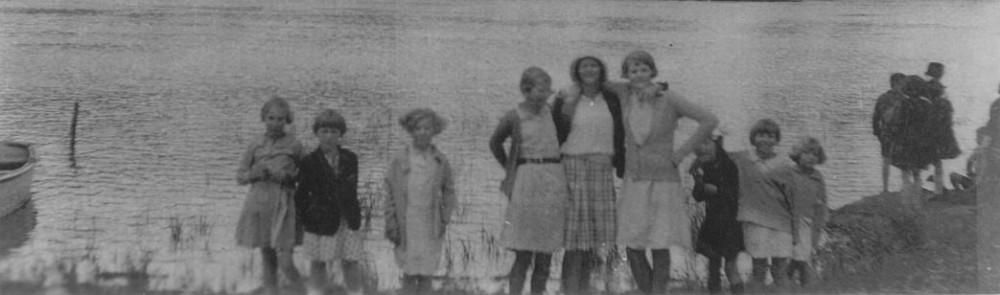
Max was looked up to by the younger kids at school who found a protector in him from the bullies. He also remembered attending school picnics out on the shores of Lake Victoria. The kids would travel on the back of a lorry to the lake and have races out there. Max was a sporty kid and enjoyed running. In fact, he was very good at it. I hear this is something he also participated in his later life with athletics events organised by his work social club. The 120-yard sprint was his specialty. Max also enjoyed playing cricket, football, as well as marbles, hopscotch, rounders and a game called Red Rover Pass Over.
Max was a strong swimmer. He rescued a boy who was visiting Lock 7 from the city who got into a whirlpool near the lock chamber. Max was only 11 at the time but he recalled the aftermath for me:
“There used to be a program on the ABC called the 5CL Boys Club which used to come through on the radio on a Monday night. Neighbours with a crystal set invited me to come down to listen. When I arrived, they switched over to the Boys Club. It was quite an entertaining program I suppose, but in part of it, they spoke of this happening at a place named Lock 7. I pricked my ears up and I thought gee, it’s up here. And they reported this near- drowning and how this little boy of 11 named Max Pearson hopped in and rescued the other boy. They sent me a medal. “
Max’s whole childhood was centred on the locks.
“The area away from the lock was foreign to us. The lock establishment where the village was and where the works were and where the river was, it was our world. When we went down to the Goolwa barrage, you could hear the sea roaring at night, and we used to wonder what all the noise was. Of course, our parents would tell us, that it was the sea, and we’d never seen the sea, so after probably a few weeks, we climbed over these sand hills and went right over the other side to have a look at the sea. There were three or four of us, standing looking and couldn’t see the other side of the water….…………. the only water we ever saw was the Murray and we could always see the other side of that…”…
Max was 16 before he lived in a house with electric light after moving to Adelaide from Goolwa. He recalled his delight at electric light at the flick of a switch and how he has never been opposed to paying the electric light bill.
Max’s affection for the river is deep in his veins. The River Murray has been a very important part of his life. Max’s attachment in particular to Lock 7 and to the history of everything connected with the lock works is obvious. I have had the pleasure of accompanying him to the patch of scrubland adjacent to Lock 7 which was once, way back in the early 30s, a thriving little community. Walking with Max through that site brings it alive for me. I can in my imagination hear the industrious sounds coming from the works, but if I listen harder, I can also hear the laughter of children and the chat of women as they gather their washing from the clotheslines strung between the trees. I can smell the smoke of stoves where bread is baking and hear the cackle of hens. I can see the lush vegetable crops that are lovingly tended to put food on the family table as well as the flower gardens planted to create some colour in this green and brown landscape. Brought back to the 21st century by Max’s voice I see hard evidence of their lives there. The scattered remnants of the concrete slurry that was their back verandah, the levee behind their house which held back the 1931 flood. The clearing remains where the sporting activity of this vibrant community took place. Max points out the location of various neighbours’ dwellings and of the school. His recall is incredible for the time his family spent in this remote but important location.
Arising from his early life, Max felt the need to take the initiative to organise a reunion of lock people. In 1997 he convened a meeting of interested people at Goolwa and a River Murray Locks & Barrages Reunion Committee was formed. As a consequence in 1998 a reunion of all former employees, wives, families, friends and relatives was held at the Goolwa Barrage. (This reunion was supported by SA Water, local Council and the Murray Darling Basin Commission). The reunion was so successful that, by popular demand, a second one was held at Lock & Weir No. 5, Paringa, in 1999.
In conclusion, Max told me: “I think that togetherness is really something that is very, very precious in life.”
We have come together today because of our connection with this inspiring and precious man who has touched and enriched our lives with his positive outlook and generous spirit.
(The above forms the text of a speech made by me at Max Pearson’s 90th birthday in 2011.)


Frederick Arthur “Fred” Sims was employed on construction work at Lock 7 on the River Murray and later at the Goolwa Barrages. During his time at lock 7 he sometimes worked as the diver wearing the cumbersome outfits required at the time.

I don’t know much about Fred before his time on the locks. However he was born on Dec 12 1901 at Dulwich in South Australia and married Roma Grace Burke on 5 July 1924 in Norwood. Fred sounds like he was quite a character, with a flair for writing. Recently, his grandson sent me what are believed to be poems written by Fred during his time at Lock 7.
These poems provide a unique insight into the past, especially when I have been able to connect up some of his subject material with real events that have been documented or which tie in with oral history I undertook for my book, Harnessing the River Murray: Stories of the People who Built lock 1-9, 1915-1935.
In 1935, when works at Locks 7 and 8 had been completed the massive task of dismantling all the equipment, workshops and cabins/houses was undertaken for it all to be transported by barge to Goolwa to commence barrage construction.
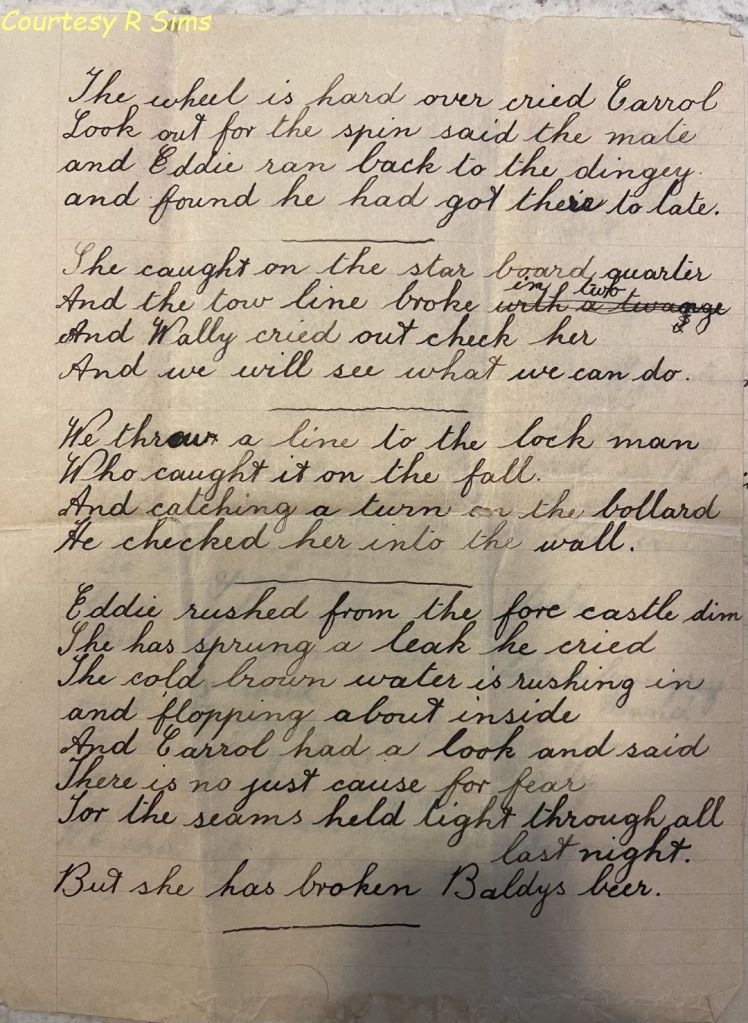
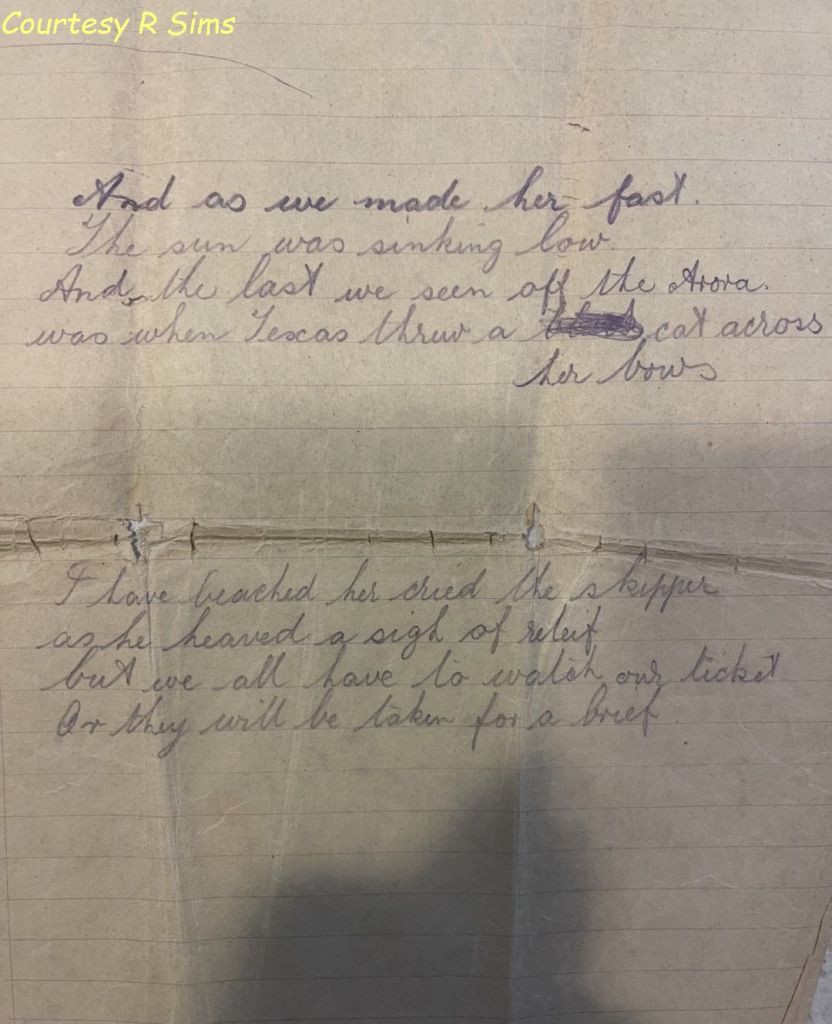
It was on one of these trips that misfortune struck the barge Aurora at Lock 5. Early in January 1935, the barge being towed by the SS Industry, hit one of the pillars of the open lock 5. See story here:
Fred Sims was an eye witness to this event and penned this amazing poem, which I have permission to share here. I think he would never have imagined when he put pen to paper that his musings would be ‘published’ on such a platform as this! Many thanks to Rodney Sims for sharing the poem (found in the possession of Darrell Sims.)




On Monday October 21 at 7.30 pm, Burnside Historical Society, (Adelaide) hosts a talk by Helen Stagg on Locking the River Murray.
Helen’s paper takes a journey through the research for her book, Harnessing the River Murray: stories of the people who built Locks 1 to 9, 1915-1935.* (*Available for purchase on the night, $45.00, cash only) She reveals her motivation to record the stories and experiences of people who did not get the chance to author their own story. Her presentation will include some of the first-hand accounts and oral history which informed her research, including a ‘metaphorical literary time-capsule’ of letters written by children on the locks in the 1920s.
All welcome. No charge. Refreshments provided.
Location: Coralie Soward Hall, Burnside Community Centre (adjacent Burnside Library)
401 Greenhill Road, Tusmore SA 5065. Enter car park from Fisher Street, off Portrush Road.


 While researching for my book, Harnessing the River Murray, Stories of the People Who Built Locks 1 to 9, 1915 to 1935, it was a stroke of good fortune that I discovered a kind of literary ‘time capsule’ containing letters from five children from one family at Lock 5. It was in “The Murray Pioneer and Australian River Record,” that I uncovered a series of letters written by the children of Arthur and Florence Rains while Arthur was employed at Lock 5, Paringa. To ‘hear the voices’ of these children over ninety years later is incredible! The five children wrote seventy-one letters between them to the weekly Young Folks Column conducted by “the Mopoke” and spoke of their time at Lock 5 camp between 1924 and 1927. This allowed me an almost tangible connection with the family as well as to the community in which they lived.
The historical records of engineering works primarily consist of the official records of the construction authorities; the insider’s view through the children’s eyes is a very rare opportunity to see the details of life at the lock camp.
If you would like to hear more about these letters and indeed of

Details of Fleurieu Peninsula Family History Group Seminar Day https://fleurieufamilyhistory.org/
the social history of the lock building communities, you may like to attend an upcoming seminar day to be held at Christies Beach, Saturday August 17. Details in the image. Bookings essential.
My book will be available for sale on the day.

Currently there is a display on ‘Locks and the Murray River System’ at the Visitors Centre in Berri, about which I am happy to have been consulted. The diving outfit on loan from SA Water takes pride of place. One of the people I interviewed for my book, Harnessing the River Murray: Stories of the people who built Locks 1-9, 1915-1935, Thelma McGair, told me how her father, who never drank alcohol, was preferred by Freddy Simms, the diver at Lock 7, to hold his air-supply line. Divers were required to investigate underwater issues to do with such things as the coffer dam walls etc.
Thursday October 4 2018 from 8.30 am till 10am, ABC Riverland with Matt Stephens, will be broadcasting from the Berri Information Centre and will air a brief interview with me about my research on the people who built the locks.The frequency is 1062 AM on your radio or you can listen Live via the ABC Listen App or via http://www.abc.net.au/radio/riverland/live/

Diver Freddy Simms, c 1932 Lock 7 with A Eddy, S Underwood and S Allen

 National Engineering Landmark at Lock 1, Blanchetown.
 historybyhelen
You must be logged in to post a comment.