Christmas Greetings: a glance back to Lock 5 1926

Happy Christmas!

Social happenings at Lock 5: Mr M S Ward (teacher) went to Adelaide on Friday.

Mr and Mrs Angus McKinnon and two children went to Semaphore for the Christmas holidays.

Mr Mrs G W Martin and children drove to Victor Harbour for Christmas and New Year holidays

Mrs H Cruttenden and infant are staying at Norwood with her mother


Mr & Mrs Richards and daughter are going to Melbourne for Christmas

Ms Gilbert is returning to her home in Melbourne

Mr Vincent and his son are going to Melbourne for the Christmas holidays

Mr H T M Angwin and his mother have gone to Sydney for Christmas

(Taken from The Advertiser 21 Dec 1926)

Your Christmas shopping solution: Social history of Murray lock work-camps

IMG_0030The ideal Christmas gift: Harnessing the River Murray: stories of the people who built Locks 1 to 9, 1915-1935’ by Helen Stagg. This book provides a rare insight into life at these remote temporary river towns up to 100 years ago.

Books are $44.95. Postage is in flat-rate sturdy postpak satchel, which means you can order up to three books for the same flat postage rate of $13.80 within Australia. For signature on delivery: add $2.95. With only 7 working days until Christmas, you’d have to act quickly as mail deliveries can be tardy. Books are securely supported in cardboard and bubble wrapped. If you live in Adelaide, we can arrange for you to pick up your copy, Western suburbs.

Message me with your order, and mail address and I will supply bank details.

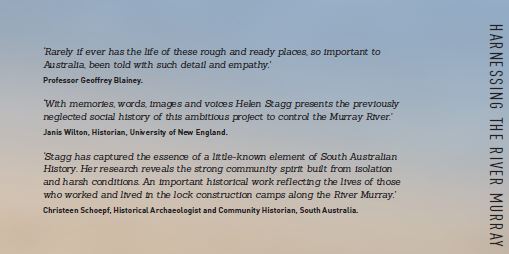
Back cover reviews

Building the Captain Sturt: Stern wheeler used in Murray lock construction

Below is the text of an interview with the American Captain who supervised the Australian reassembly of the sternwheeler Captain Sturt. text from The Advertiser, (1916 11 25)

NEW MURRAY STEAM BOAT: INTERVIEW WITH CAPTAIN MEREDITH, A VETERAN AMERICAN.
Captain Washington Meredith, of Cincinnati, Ohio, who has completed his task, under contract with the South Australian Government, of putting together the Murray River steamboat, Captain Sturt, which is to be used in connection with the building of the locks, is a living contradiction of the statement that in America a man is too old at 40. He has been building river boats for 65 years, and on December 6 he will celebrate his 76th birthday. Captain Meredith will leave, by train for Sydney today to catch a steamer for San Francisco, and on arrival there he has to undertake a rail journey of 5,000 miles before he gets home. He says the Captain Sturt is an experiment as far as river navigation in Australia is concerned inasmuch as it pushes its freight ahead instead of towing the barges astern but it is by no means an experiment as regards the United States, where the Charles Barnes Company, the constructing firm, has 100 craft of the same type plying up and down the Mississippi, Wabash, Kentucky, Alleghany and various other rivers. The Captain Sturt is the eleventh of the type Captain Meredith himself has superintended in construction, and in his opinion they have no equal for the handling of barges and derrick and dredge boats.
“She should be a success in every way,” remarked the captain in an interview on Friday concerning the new steamboat. ‘The Captain Sturt will revolutionise the methods of towing on the River Murray. Provided that she is handled properly she will do just as good work as our boats are doing on the American rivers. If she does not, it will be the fault of the man at the wheel and the man at the business end as we call the engine-room.  Although the parts were shipped from New York, the actual construction here is by Australian labour, every bit of it.
I started with 10 men working under my direction, and wound up with 25. I had the aid of only one mechanic (an iron worker). The others did not know how to tighten up a bolt or drive a rivet, but they were young and willing to be taught, and proved as time went on to be A1 at the job. It cannot be denied that they have done first-class work.” Captain Meredith arrived in South Australia at the end of October, 1915. The new steamboat is specially adapted for carrying stone from the Mannum quarry to the lock sites. She was submitted to a stiff test a fortnight ago, with excellent results. The down trip from Blanchetown to Mannum was made in five hours. On the following morning she went to a spot 18 miles below Mannum, where a barge had been sunk and raised, and brought it to Mannum the same evening. The next morning three barges full of water were pumped out and hitched on to the Captain Sturt, which backed out from Mannum in a high wind with the four barges ahead of her. To continue the narrative in the American skipper’s word, “She straightened them up and started right on up the river to the quarries, took on some wood, and continued the voyage. Her average push up the river with all this load was four miles an hour. The barges were in front, spread out to a width of 81 ft and the whole fleet was 265 ft long. She made every bend of the river without once slowing down the engines. Five barges could have been steered up the river equally as well as the four. Coming downstream the Captain Sturt could bring 16 barges and handle them. With big boats of the same type we have pushed 60,000 tons at a time from Pittsburg to New Orleans, about 1,750 miles.
Captain Meredith has been on every navigable river whose waters flow into the Gulf of Mexico. He has been 1,800 miles up the Yukon, in Alaska, and 350 miles up Birch Creek, which runs into the Yukon Flats. “The Murray” he stated, “is so pretty a river as I was ever on. Of the American rivers it brings me most in mind of the Monongahela, although the Murray is larger. The country I have seen in South Australia is like the part of America that has to be irrigated. The Australians with whom I have come in contact have been fine people. They have treated me royally, and I thank them for it.”
The parting words of the American steam boat builder were, “Good-bye, and don’t forget to say a good word for the boys who helped me to put the Captain Sturt together.”

Lock 1: early stages

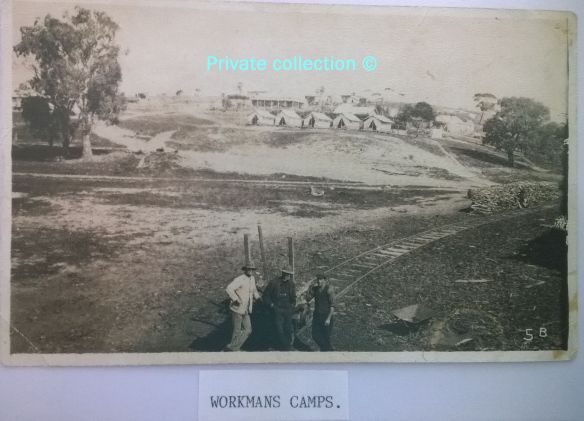
With World War 1 underway, the call to duty was taking labour away from the state (and eventually from the works. Despite a ‘season of unprecedented financial stringency’ due to the war-time economy, some public works had to proceed; those involving water supply were seen of utmost priority, essential to national development and to guaranteeing water security for South Australia. The Millbrook reservoir, the Encounter Bay Scheme and the Warren Weir Scheme in the Barossa along with the River Murray works were going ahead as planned.[1] To provide for the ‘camp’ that was developing at Blanchetown and which would be characteristic of each site, Engineer Cutting was working on the establishment of a mess for the men where meals would be provided. By 15 February 1916 there were about 50 men employed on preliminary plant and site construction at Blanchetown. By April 1916, with a start already made on cofferdam number 1, worker numbers had increased to 61 and nearly all the required machinery at Blanchetown had been installed.

The photo from the Reed family collection is most likely taken of Blanchetown, circa 1917. James Clifton Reed was initially employed at Lock 1 as storekeeper but also worked as time-keeper at Locks 9, 4 and 7 before becoming Superintendent at the Lake Victoria Storage.

[1] Register 1916 02 15, p 6.camp-poss-blanchetown-copy

News Flash! History and Genealogy Expo Adelaide

I will be at the Australian History & Genealogy Expo in Adelaide this week, from noon Friday 7 Oct till 5 pm and then again on Saturday Oct 8 from 9 am till 2 pm. Find me at the Engineering Heritage Australia exhibit with my books which I will be happy to sign. Buy your copy, ideal Christmas gift and save postage costs!

I am also speaking at 4.30 Friday in Mini theatre 1 on my research. The talks in the mini theatres are free with your expo admission. I look forward to meeting you.

slide-ad

(NOTE CASH SALES ONLY for the book)

expo-2016-provisional-program-v4b

One year since the centenary celebrations

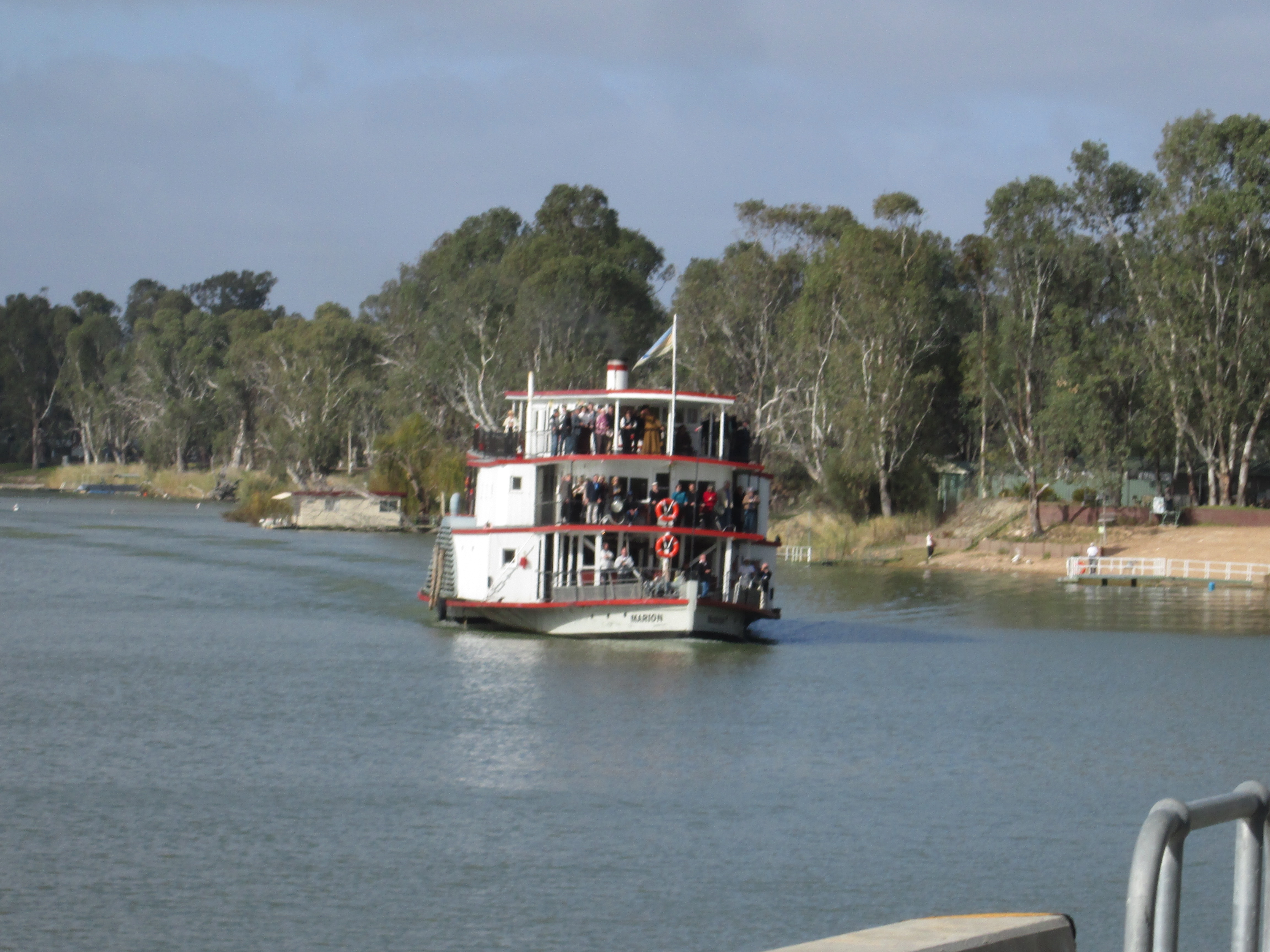
Last year, this day was marked by a large gathering at Lock 1 at Blanchetown to re-enact the laying of the Foundation Stone signalling the start of locking the river. Just as had happened 100 years before, the PS Marion arrived carrying guests, a band played, children formed a guard of honour and speeches were made. Also my book, Harnessing the River Murray, stories of the people who built Locks 1 to 9, 1915-1935, was officially launched.

The centenary plaque, Blanchetown.

The centenary plaque, Blanchetown.

The Murray Pioneer wrote of the Foundation Stone event back in 1915, as follows:1915 06 03:
A stone to mark the site of the first lock in South Australian territory will be laid by the Governor (Sir Henry Galway) next Saturday afternoon (June 5th). A large Parliamentary party will leave Adelaide on Friday evening for Murray Bridge, where they will go aboard the S.S. “Marion”, which is being especially fitted up for the occasion under the supervision of the Chief Engineer of the Gem Navigation Company (Mr. Fuller). Including the crew, there will be over 120 passengers on the boat, which will be the home of the party till the following Monday morning, when a special train for the city will be boarded at Goolwa. The Prime Minister (Mr. Fisher) and Mr. Holman (Premier of New South Wales) are expected to be members of the party and to speak at the stone laying function. This is timed to take place at 2 p.m., but a glance at the timetable indicates that it may possibly be later. Parties from Renmark and Loxton will probably motor to Blanchetown to witness the ceremony. As the first lock is to be called the William R. Randell lock, it is fitting that Captain Randell [W. R’s son, who was chief engineer and water master for the Renmark Irrigation Trust] should be among those going from Renmark.

The Marion steams into Lock 1, June 5, 2015

The Marion steams into Lock 1, June 5, 2015

The 1998 Lock and Barrage Builders’ reunion at Goolwa

Murray Brooks, Charlie Adams, Max Pearson and Pat Reed. Other men not known.

Murray Brooks, Charlie Adams, Max Pearson and Pat Reed. Other men not known.


On March 7 and 8 1998, over 300 people gathered at a reunion of former lock builders and their families at Goolwa. The memories of Charlie Adams, Max Pearson and Murray Brooks (pictured), along with those of other ‘children’ at the locks during the construction years, feature in the book Harnessing the River Murray. Maybe you can identify the un-named men in the photo. Please contact me if you can.

News article about the reunion with Charlie Adams and Sheila Trafford-Walker pictured.

News article about the reunion with Charlie Adams and Sheila Trafford-Walker pictured.

Food on the table at the lock camps: as recalled by Charlie Adams.

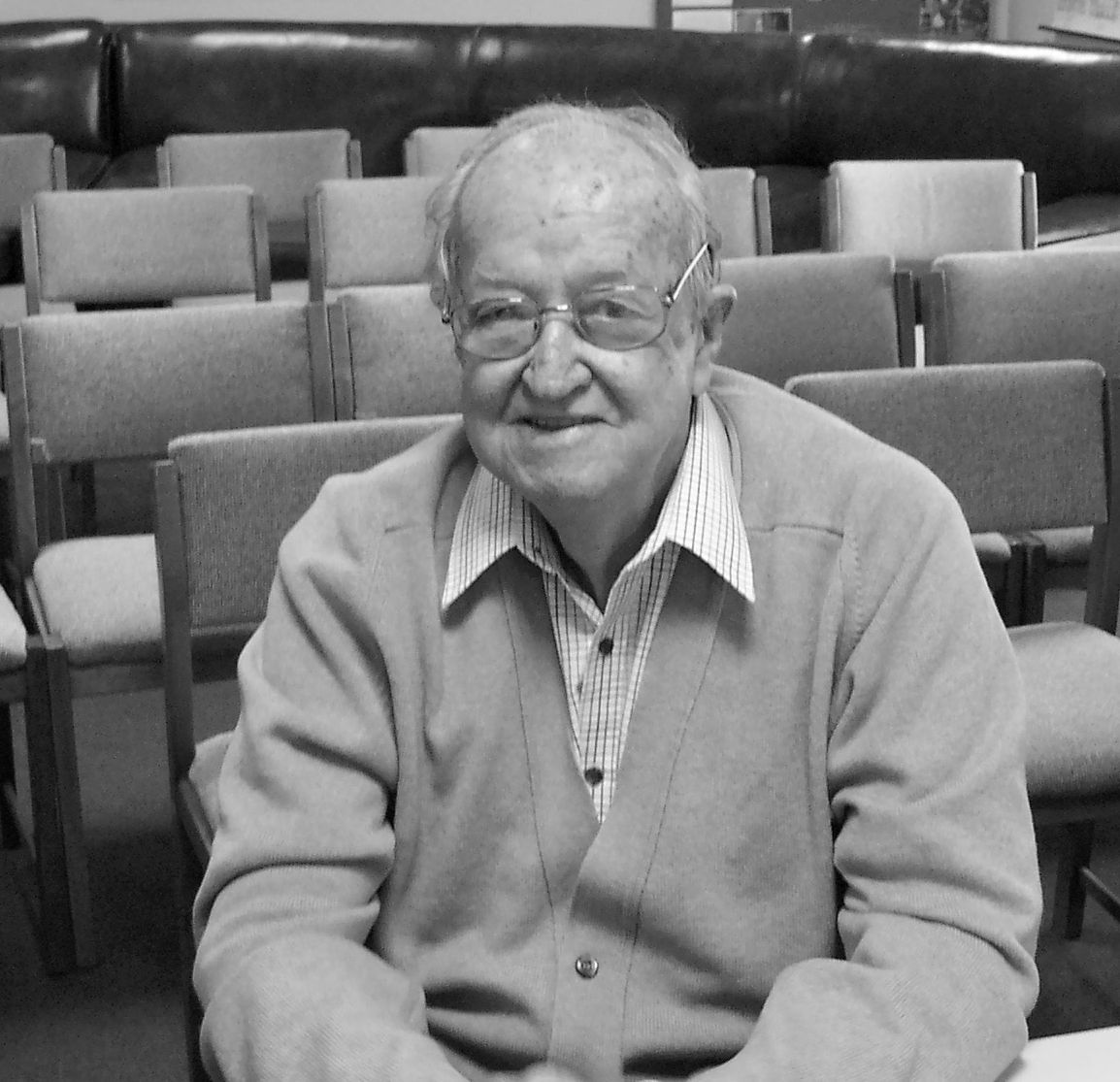
Charlie Adams on the day of the first interview, Mildura, Victoria. March 1 2010.

Charlie Adams on the day of the first interview, Mildura, Victoria. March 1 2010.

When I first interviewed Charlie Adams (March 2010) who spent his entire childhood moving from one lock to the next while his father was employed on the construction, he described the supply of basic foodstuffs to the people in the ‘lock camps.’
“There was the government store and you used to buy your groceries at that store. But also at Lock 7 there was a private store with a post office attached to it, next to the school. I think it was Coombes who had the Paringa store (who conducted the store at Lock 7).
Milk you got wherever you could get it. At Lock 4, Quasts (at a neighbouring farm) supplied milk; at Lock 7 one of my uncles had a couple of cows and so he supplied milk. That was another job I had of a night after I come home from school. So I could get a ride on the bike, I used to bring the cows home for him to milk. I always found them out in the bush because they had a bell tied around them and you could hear them for miles.
Mum didn’t make butter but she did make a lot of bread and any surplus bread she sold to anyone else who didn’t have bread because the bread only came on the mail about twice a week. The same with the butcher; he came around once a week from Wangumma station, Mr Scadding. He used to come round with his truck selling mainly sheep, lamb, mutton, (there) could have been a bit of beef. One of the prime things was rabbits: if it wasn’t for the rabbits, thousands of people would have died of hunger. We used to go out and set traps and catch rabbits. I enjoyed it.
Fish was plentiful and you’d go down and throw the line in to catch a cod. There was a fisherman used to live with the Blakes at Lock 9, Lock 4 and Lock 7 and he was a marvel. He’d just take his fishing rod which was a sapling, a young tree; take it down and it didn’t matter where he threw the line in, he’d pull out a fish.
We (kids) used to go down the creek yabbying and used to get yabbies, (with) either nets or little lines and pull ’em in. We didn’t get many ducks but they were there and if somebody brought home a duck, ok you had a duck.”

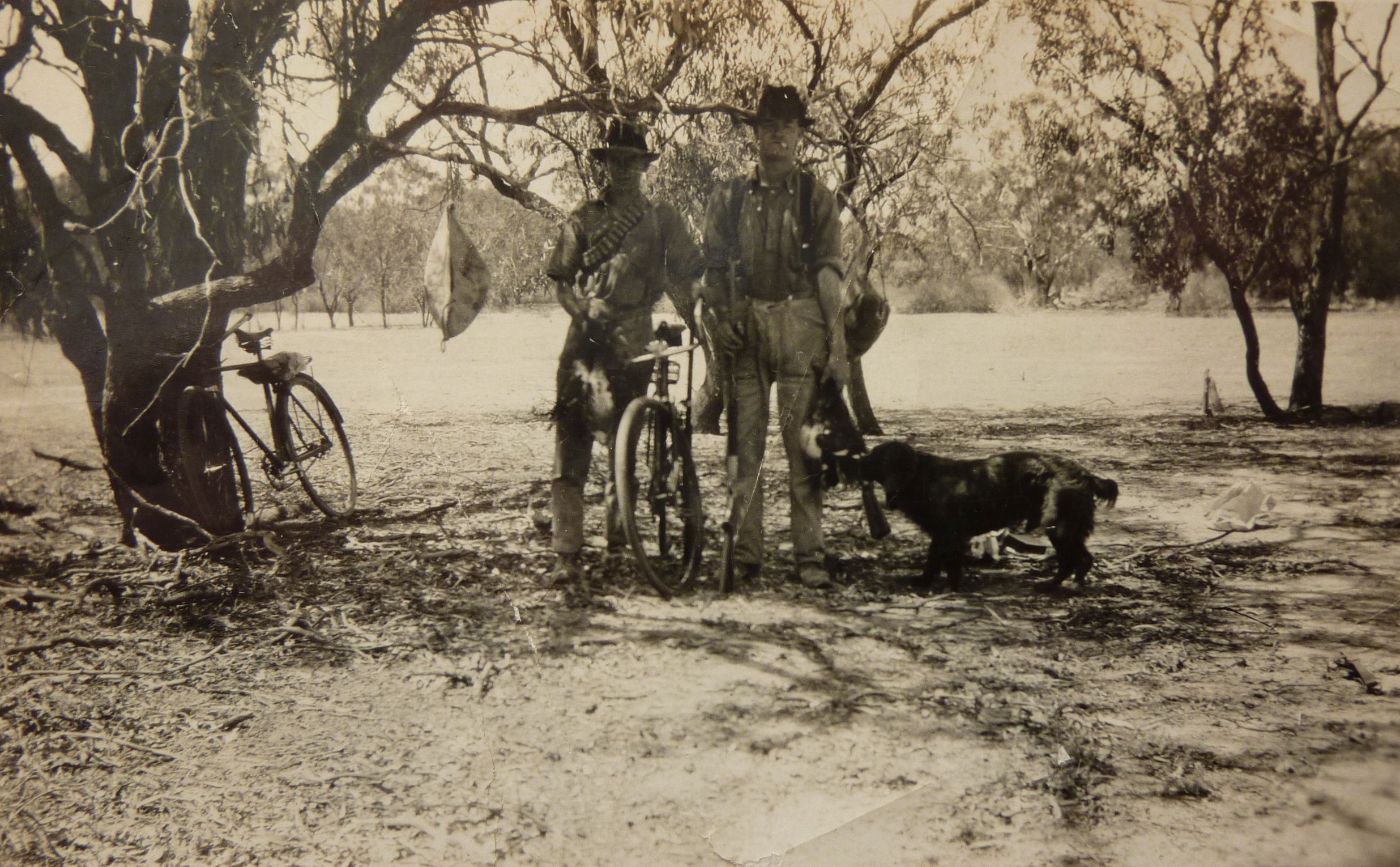
Bill Pearson (left) and Harold Pearson (right) duck hunting with their dog at Lock 4

Bill Pearson (left) and Harold Pearson (right) duck hunting with their dog at Lock 4

Global Day of Engineering

Today on Global Day of Engineering, I acknowledge the hard work and commitment of all engineers associated with the lock and weir construction. From the Engineer in Chief down to the assistant resident engineers at each lock site, the massive work was undertaken with intelligence and attention to detail, on structures which have stood the test of time. A number of Engineers associated with the Locks can be seen here: SA Water Flikr

From Chapter 2 of my book, ‘Harnessing the River Murray’:

Having passed the Murray Works Act (South Australia) in 1910, the South Australian Engineer-in-Chief (1909-1918), Graham Stewart, went to England and America early in 1911 in search of an eminent engineer to conduct surveys and draw plans for his state’s locks and weirs. The American expert, Major Edward Neele Johnston, assistant to the Chief Engineer of the United States, with his extensive experience in lock and dam construction, especially on the Ohio River, was engaged. In October 1913 Johnston’s report was tabled in South Australia’s parliament. South Australia’s Legislative Council then decided to proceed independently with the locking of the Murray as far as Wentworth, which would allow permanent navigation for 1,065 miles along the river with a minimum navigable depth of almost 6.5 feet.

Johnston had examined the various sites, sunk trial holes in the river to test suitable foundations, and made detailed drawings of the first lock. All that remained was to call for tenders. Johnston recommended appointing Robert C Cutting, a civil engineer with practical experience in lock building in America, as resident engineer for the first lock. Cutting arrived in 1914 and undertook the planning and start of the project, including the submission of large scale orders for heavy machinery and equipment from overseas and local sources. …

See State Records SA tweet here.

Modern book publishing

What a great innovation Print On Demand is for modern-day writers. With digital printing, customers can order 1 or 100 copies of many self-published books. Harnessing the River Murray: stories of the people who built Locks 1 to 9, 1915-1935 by Helen Stagg is one such example. Click here to order your copy now! Print on Demand: Harnessing the River MurrayWP_20150819_005